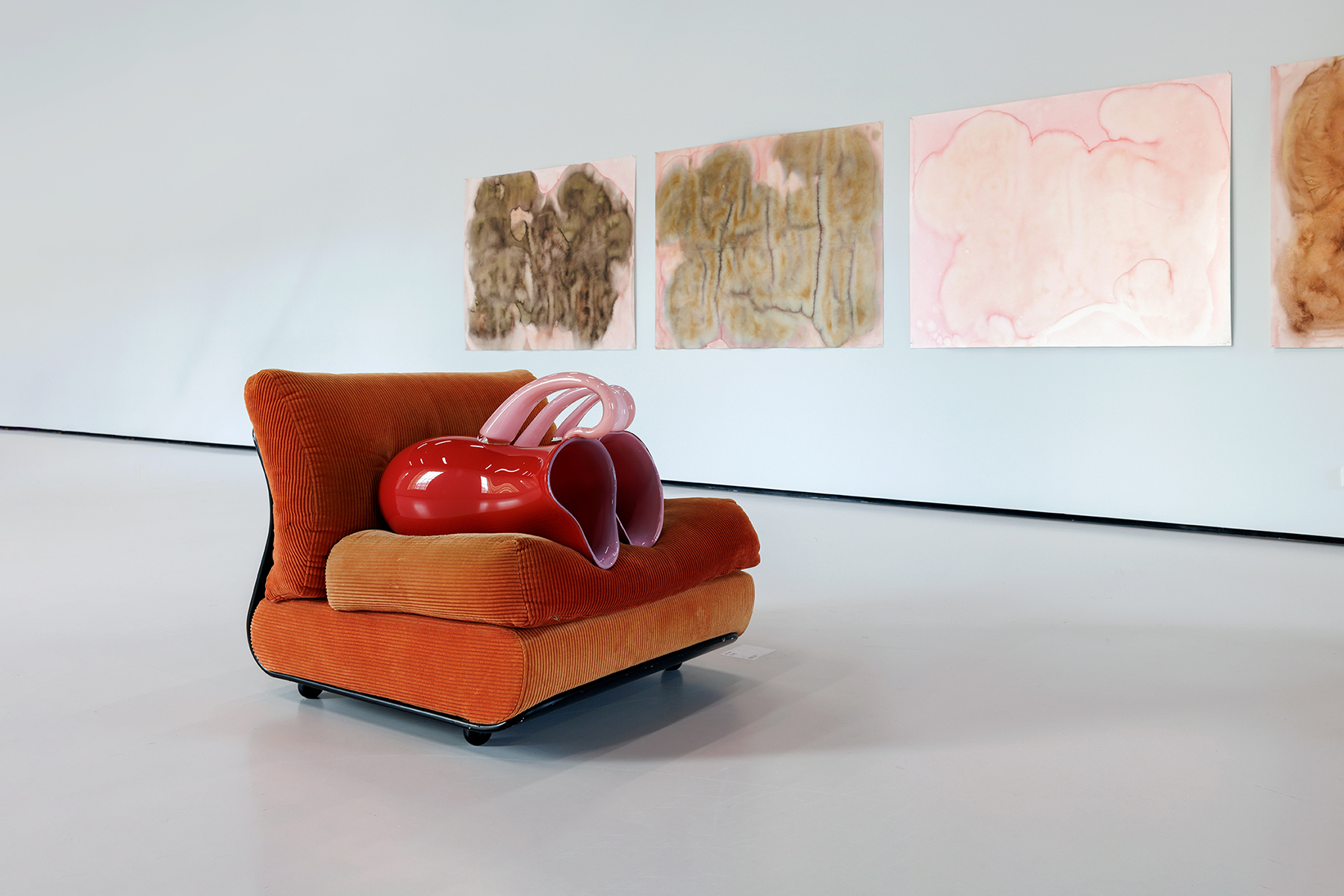
Maria Goosen’s work deals with life and its transience and is frequently shown in group exhibitions focusing on the female perspective, at special heritage locations, and outdoors in public spaces. Stedelijk Museum Schiedam believes it is time to pay tribute to one of the grandes dames of Dutch visual art and has brought together more than sixty works for this solo exhibition.
The exhibition, curated by Inez Piso-Tuncay, offers a glimpse into Maria Roosen‘s broad oeuvre, her working methods, the way she experiences the world around her, and how she directly incorporates this into her work. Central to this is her intensive way of working, in which everything arises from observation, intuition, and physicality. The practical, repetitive actions of her working process are a way of getting to the essence of what she wants to convey. Everything then comes together in ‘solidified energy’: in soft and hard materials such as glass, paper, and textiles.

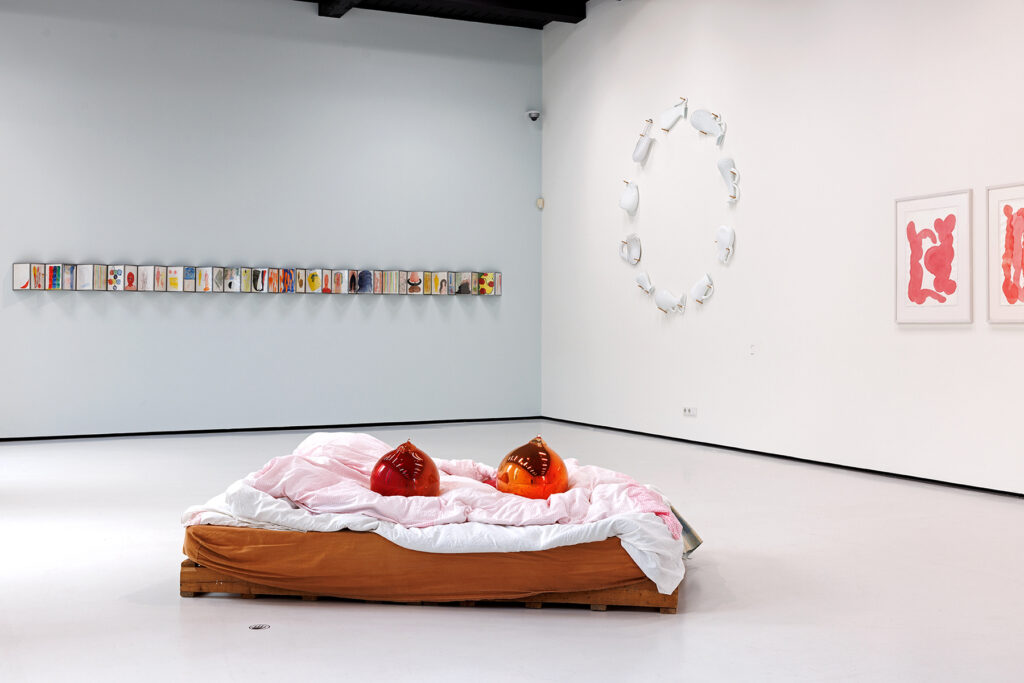

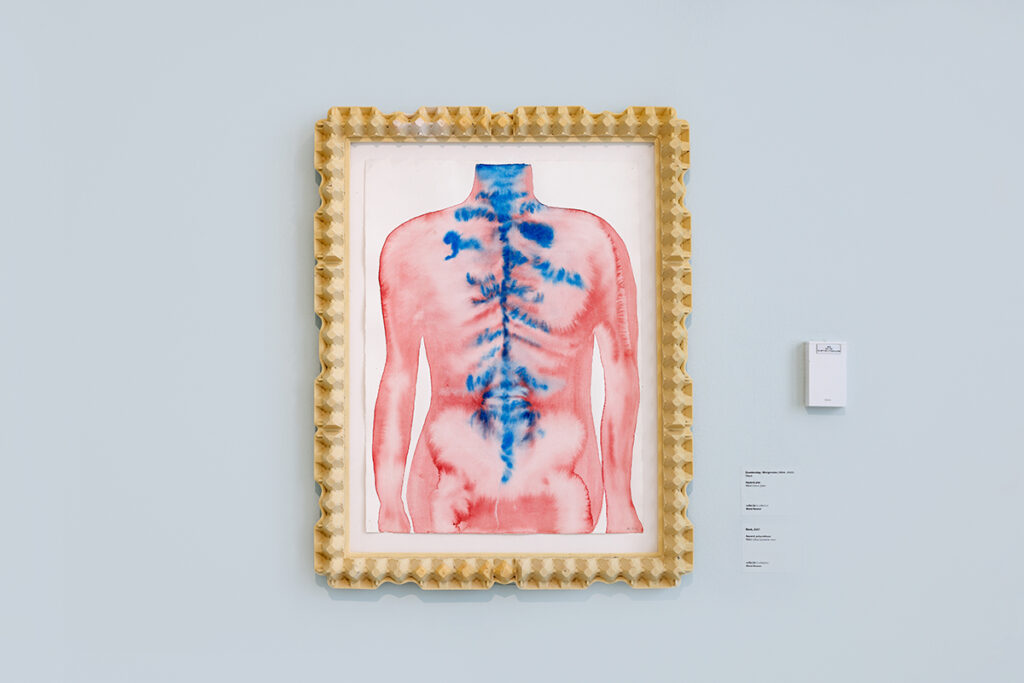
The personal touch is evident throughout, and is reflected in the series of ‘Diary Drawings’ from 1988-1989. The drawings are notes of things that caught her attention or preoccupied her during a period in which she made at least five drawings of the same subject, until everything she had conceived had disappeared and only the essence remained, and she felt that her hands were drawing for her. In the preparations for Scrubbing Raking Pouring Sweeping, these drawings resurfaced and proved to be just as important so many years later.
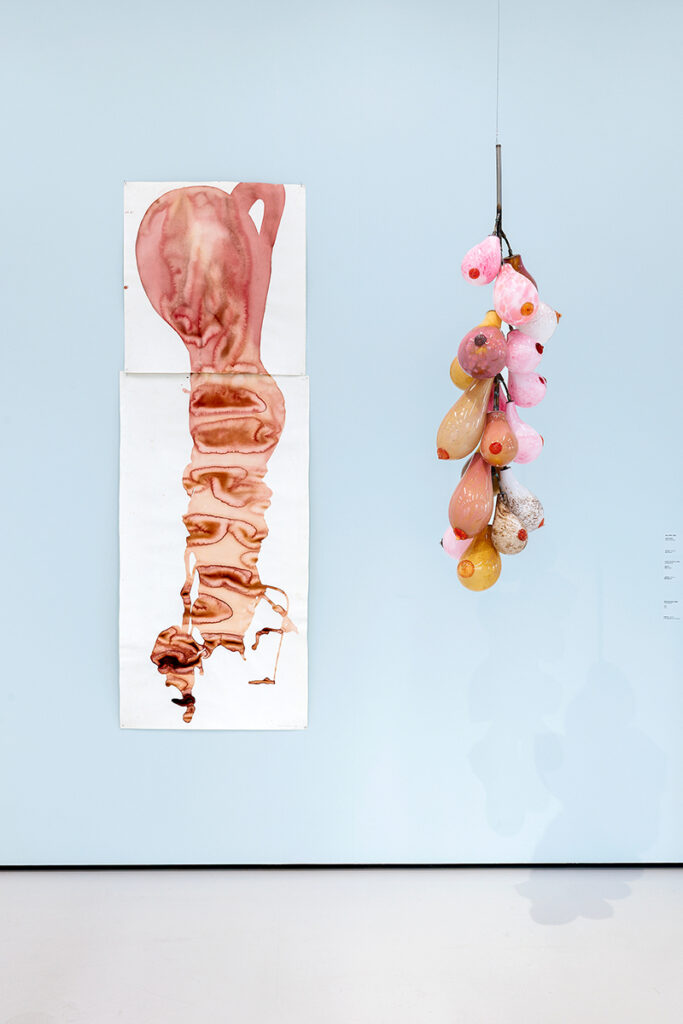
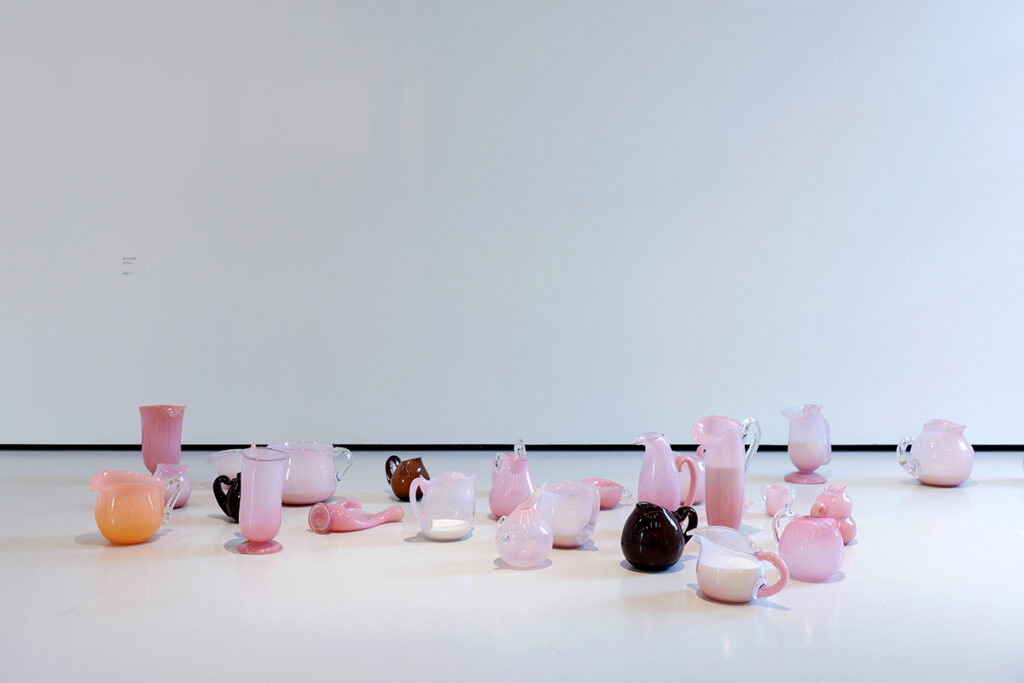
The exhibition also shows the relationship between the different forms of expression used by Maria Roosen, such as between her watercolors and sculptures. For example, while creating pink watercolors, a “jug” shape once appeared on paper. This made her curious about what pink jugs would look like in glass. Since then, the jug has been a recurring motif.


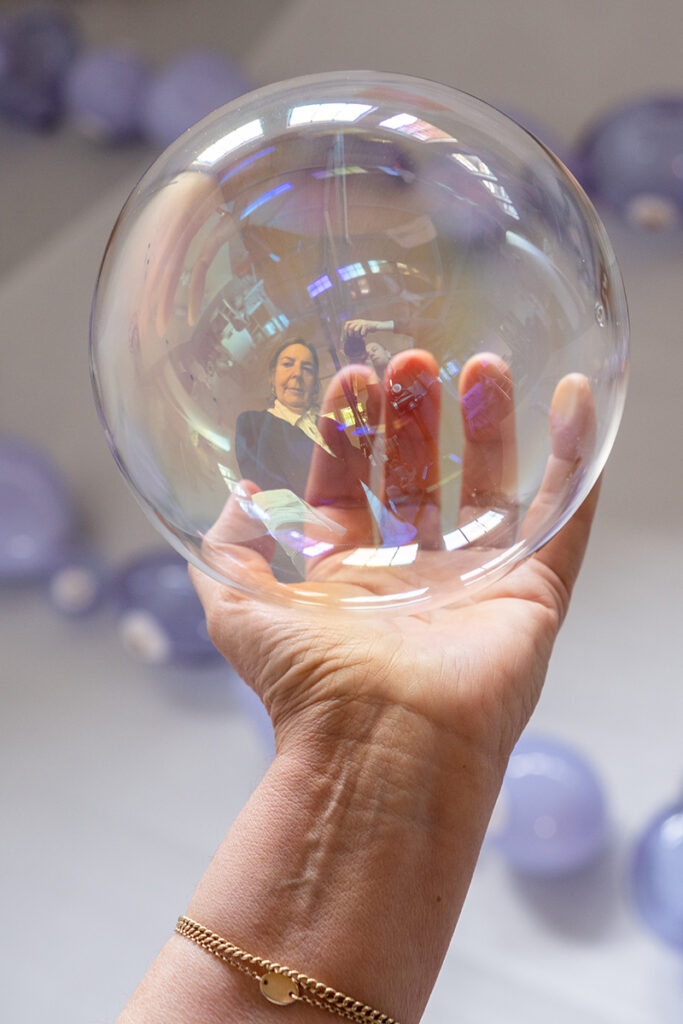
The round glass sphere is the starting point for all blown glass work, ensuring that the glass is evenly distributed. This shape embodies a tension between ‘being there and not being there’. You see yourself in it, and you see the world upside down in it. You don’t know where the beginning or the end is. The shape is strong and fragile at the same time. The energy of the blowing remains trapped inside it – almost like solidified movement. (…) Maria Roosen: “Everything is round: molecules, cells are round, the earth is round, we are round.”

The ‘Jug’ as a symbol
Although she is best known for her breast-shaped sculptures, ranging from two hanging breasts to entire clusters of breasts, Maria Roosen actually sees the ‘Jug’ as the symbol of her work. It represents giving and taking, pouring and catching. Her ‘Jugs’ are containers for liquids, but they also originate from liquid: first in watercolor and then in glass. The ‘Jug’ is thus the poetic symbol of the exhibition and recurs frequently in various works. The work Isabelle, Charlotte, Marlene, Juliette, Georgina, Cecilia, from 2009, consists of six jugs in a row, attached to the wall. The work came about because the jugs are so heavy that you have to carry them next to you like shopping bags and can only lift them to waist height at most. So the weight determines the height. They were then all given women’s names. In this way, Maria Roosen creates the final image and the meanings that you can then attach to it.
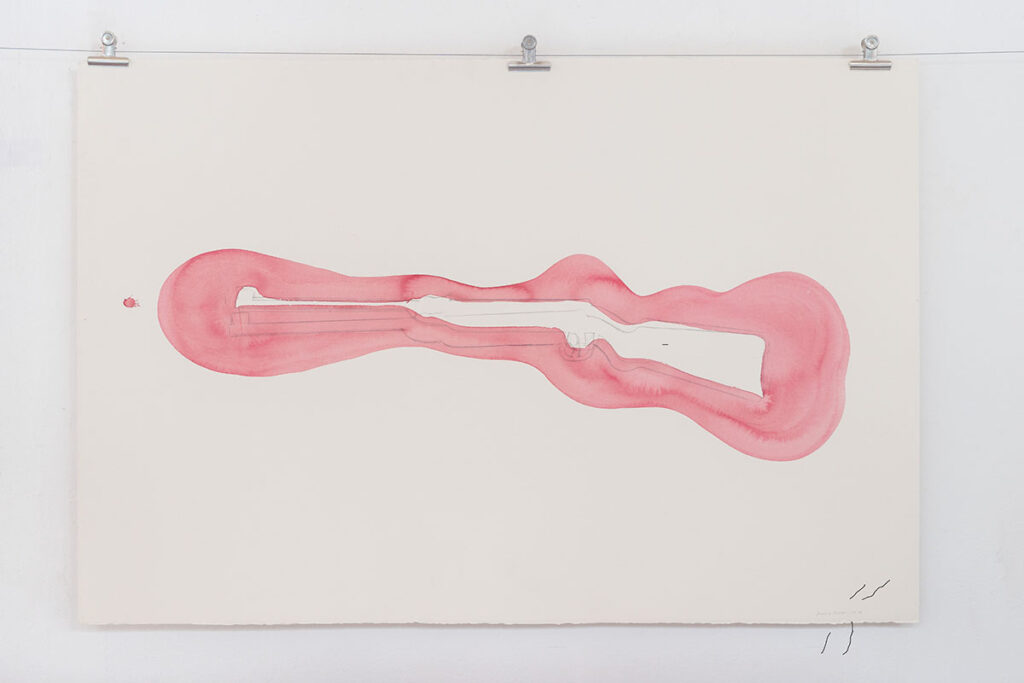
Maria Roosen has created a number of new works especially for this exhibition. In the first room, for example, we see a previously unseen pencil drawing of a rifle, enveloped in soft pink contours in watercolor. You could see a bullet in a drop. The artwork questions the contrast between hard and soft, male and female. The drawing was created because Roosen wanted to disarm the weapon, something that is particularly urgent and topical at this moment in time. The exhibition as a whole also aims to evoke softness, openness, and intuition in a world full of judgment and harshness.


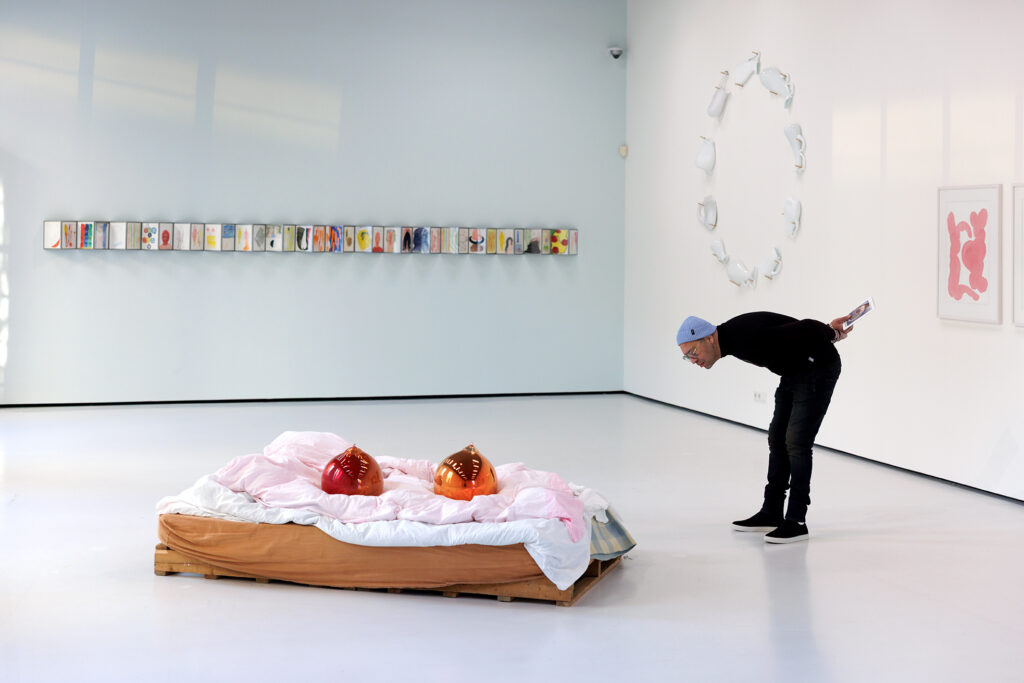
For Maria Roosen, ‘flowing along in a fluid manner’ is an important theme in her oeuvre. Literally, in her use of watercolor paint and liquid glass, but also mentally. She works very closely with other creators to realize her ideas and sketches in glass, textiles, or wood. Collaborating with craftspeople enriches her knowledge and inspires her to do new things, learn new skills, and challenge herself. More knowledge means more freedom for the image.
Exhibition ‘Maria Roosen – Scrub Rake Pour Sweep’
Stedelijk Museum Schiedam
22 November, 2025 – 3 May, 2026
stedelijkmuseumschiedam.nl
Photography: Aad Hoogendoorn
