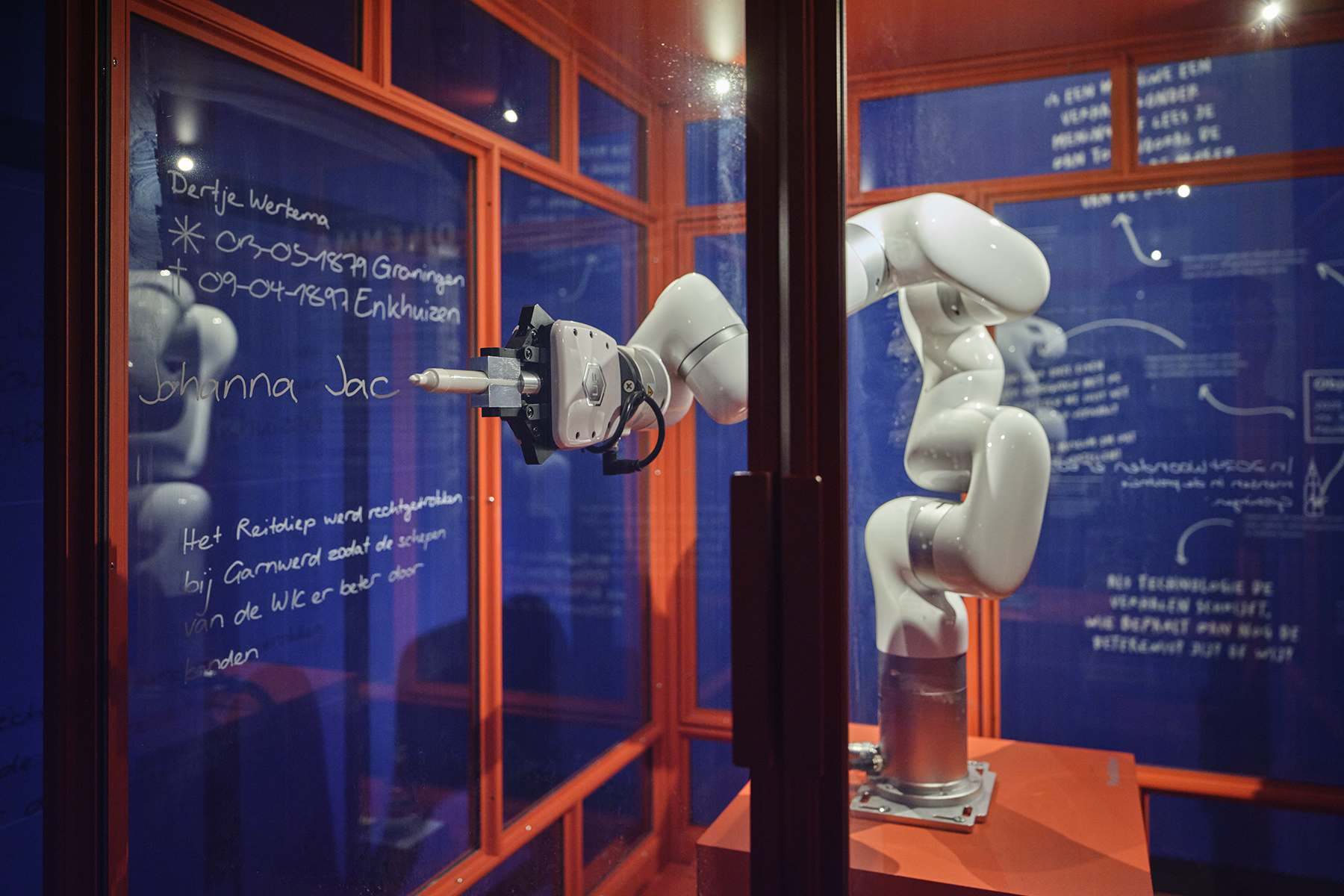
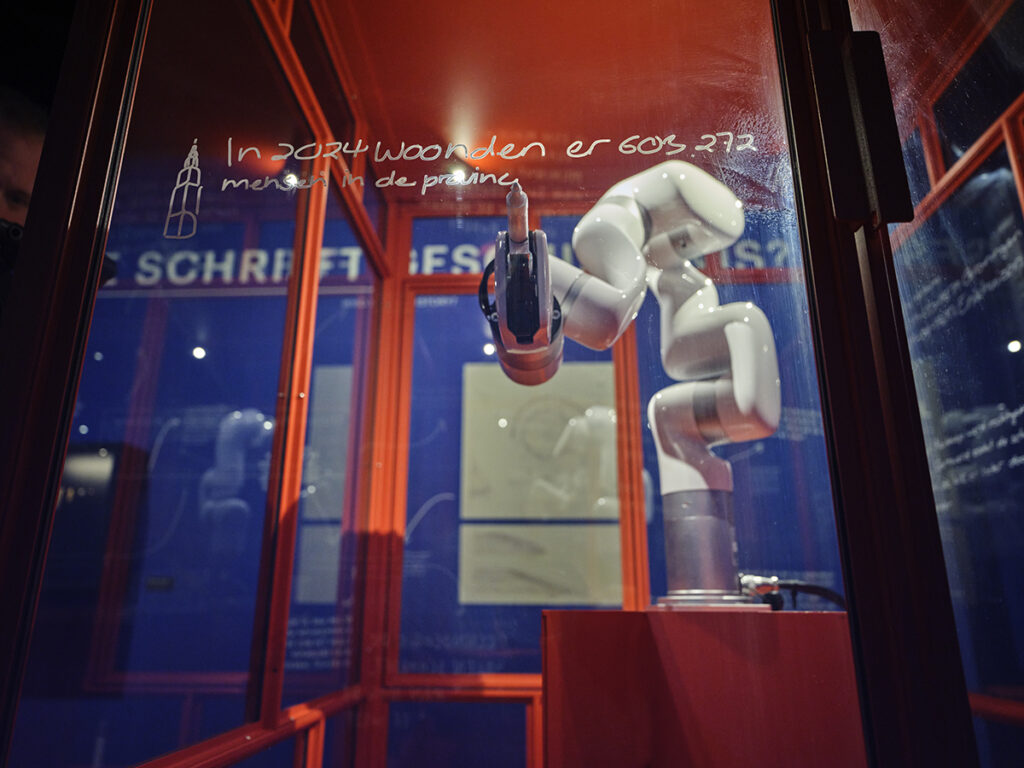
Writing History was developed for Museum aan de A: an autonomous art installation in which an industrial robotic arm in a glass display case literally writes and erases history.
The installation visualizes how the present constantly transitions into the past. What appears on the glass can disappear seconds later. This creates a continuous movement in which history is not static, but constantly re-created.

Historical Facts and Real-Time Data
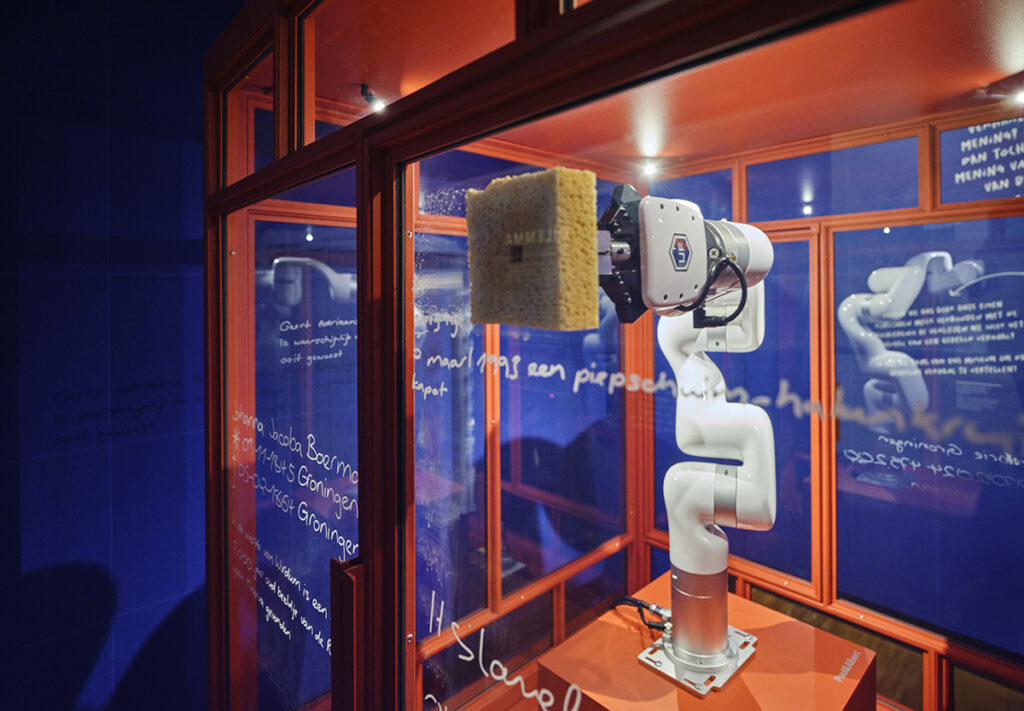
The robotic arm is programmed to function completely independently. It writes with a marker, erases with a sponge, and draws its content from an extensive database of Groningen historical facts and illustrations. It also processes real-time data, such as water levels, traffic flows, and weather conditions. This ensures the installation remains constantly updated and ever-changing.

Development Process
Creating the installation required a careful and technically precise development process. Research was conducted into the durability of markers, how to optimally moisten a sponge, and how minimal tolerances in glass influence the movement.
A magnetic spring system was used to find the perfect balance between the marker, gripper, and glass. The display case, 200 kilos of steel, is specially designed to safely absorb the forces of the robotic arm.
Industrious and Friendly
Although the installation is technically complex, the robotic arm has been given an almost human appearance. Subtle behaviors—a moment of rest, a light “breath,” a spelling error being corrected, a glance at the written word or at a visitor—give the installation a recognizable and friendly character.
Writing History can be seen until April 6th in the pop-up exhibition of Museum aan de A at the Groninger Museum.
Client: Museum aan de A
Concept, design: Paul&Albert
Programming, robotics, kinematics: Leander van Boven
Data: Groningen Archives, Museum aan de A
Datafeed/management system: Tapart
Showcase production: Edobode
Other production: Jaap Zandt, Bart Kempinga, Gerard van der Beek, Klaas van Driezum, Luminoxx
Photography: Roelof Bos
Film: Koen Leerink


