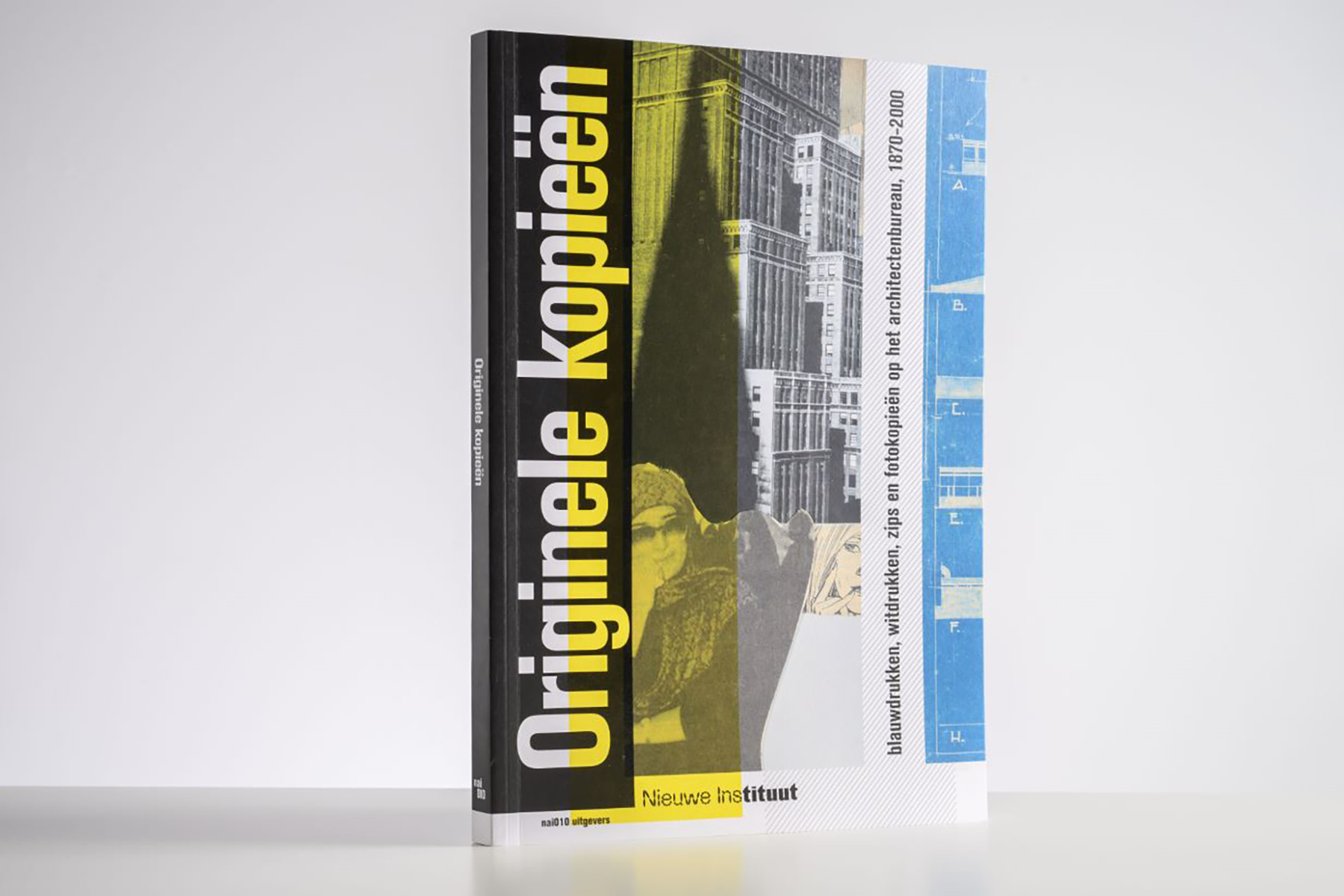
Review by Chris Reinewald
Architects and designers convert their sketches using reproduction techniques and then continue to work on them. In this way, a rough inspirational sketch develops into a detailed drawing or a polished final presentation for the client.
Het Nieuwe Instituut Rotterdam chose the specialist overview book ‘Original Copies’ from their beautiful image archive of drawings by leading Dutch architectural firms: from Cuypers to Coenen.


Until the mid-19th century, architects had to copy their building plans by hand. This time-consuming copying process continued until photographic reproduction techniques became available. Around 1870, architect Cuypers (Rijksmuseum) worked with fragile blueprints (cyanotype), the first chemical precursor to photocopying. In addition, clear white printing techniques emerged in 1890. These remained popular for a century because they allowed for multiple small adjustments.
Rietveld liked to make changes by drawing on the copy or marking it with color, as in his loose floor plans for the Textile Fair (1955).
Around 1960, larger architectural firms no longer outsourced their drawings to reproduction companies but printed them on their own photocopiers.

With American zips (1945-2000), architects without beautiful hand-drawing skills could also create impressive “art impressions.” You laid different colored adhesive films on top of each other and complemented them with standard grids, trees, street tiles, people, cars, or texts. Graphic designers also worked with these Letraset and Mecanorma rubbing systems.
More readily available visual material and the first color copiers (Xerox, 1973) encouraged designers to combine collages into “mood boards.” This made architectural drawings more versatile: political statements or artistic interpretations. Aldo Rossi and Jo Coenen copied facades or parts thereof onto their beautiful, postmodern colored pencil drawings, but then detailed them slightly differently.


The fact that this studiously composed book turned out to be an outstanding example of book design is thanks to Maureen Mooren. Using reproduction techniques, the book designer playfully and insightfully varies the layout and paper type, from matte to glossy. Detailed photographs by Johannes Schwartz prove that architectural drawings are a visually captivating source of information.


Originele kopieën
Authors / editors: Ellen Smit, Clara Haardt, Hetty Berens, Carolin Lange
Design: Maureen Mooren
Publisher: nai010 uitgevers in collaboration with Nieuwe Instituut
‘Originele kopieën’ have been selected for the Best Dutch Book Designs 2025.


