Report by Anne Pieterse
On my way to the Artez Product Design finals, I see the theme that this group of young designers has embraced: “A Good Day To ____”
They describe it themselves as follows: “A good day is made, not found. If one looks closely, each day carries something worth noticing and zooming into. Through spontaneity, playfulness and curiosity, we build a stage to explore, reflect and discover the familiar in unexpected”
It is striking that the various “good days” described by the designers themselves in the exhibition often revolve around observing and noticing. For some, this means observing nature; for others, observing “the ordinary.” However, the creators describe various forms of observation independently of one another: observing how you eat, how light shines through the trees, observing details, or observing in general.
For many designers, observing and analyzing are part of the design process, but it is striking that so many recent graduates identify this as a core value of their favorite day.
Designer Iñaki Rego Rivera describes the perfect day as one in which there is space and time to pause and observe his surroundings. This is immediately reflected in his work, which centers on observation and focuses on a single object: corn. Iñaki has developed various tools to analyze corn kernels through different senses, in part to show the viewer that there is more to a corn kernel than meets the eye by telling these stories through observation.


A similar kind of observation and revaluation of (plant) life is found in the work of Raven van der Stouw, who, with De Struikrover, takes people on an adventure in nature. By showcasing foraging and the world of edible plants, Raven aims to connect people more closely with nature and the food we can “forage” ourselves to cook with.

The eye for detail and attention to detail that the designers describe in their own “good day” is also reflected in their work for example, in that of Nalani Montague, who plays with patterns she finds in nature. It’s a fairly direct translation into textiles, presented in large canvases and various samples.


In the same room, Suze Witteveen also presents her work Sequence, yet another designer who plays with observation and delves deeper into patterns and structures. Suze focuses on structures and symmetry in her work and presents various objects that reflect this. A lamp made of repeating sheet material and several hanging works illustrate her narrative, aesthetic pieces in which you won’t easily discern the beginning and end of the lines.

Another recurring theme is the observation of everyday actions. This is evident in the work of Jasmin Öztürkkan Menda, who explores our relationship with food. Her work also focuses on slowing down, experiencing, and, above all, approaching food and the actions surrounding it with mindfulness. Jasmin explores the relationship between food, the objects involved, and the person’s interaction with the food. Her dream is to collaborate with chefs so she can further share this experimental approach to food with others.


Yet another graduate reflects on sports and the way in which fitness can take on an almost religious character, a new form of meaning and a higher purpose. The objects presented by Pim Groothuis are a unique interpretation of the hyper-masculine world explored in his work. These exercise mats are engraved with religious-looking symbols, and when placed side by side, these “artifacts”, as Pim calls them, form a veritable altar.


For me, this quest for slowness, observation, a return to pure aesthetics, and the search for a higher entity are very characteristic of the era in which these graduating students grew up, an era of technological advancements, digital lives, accelerated modes of communication, and energy-guzzling algorithms. This framework and the context in which these works were created are most noticeable in their absence; the works are about slowing down and sometimes even literally draw on old technology.
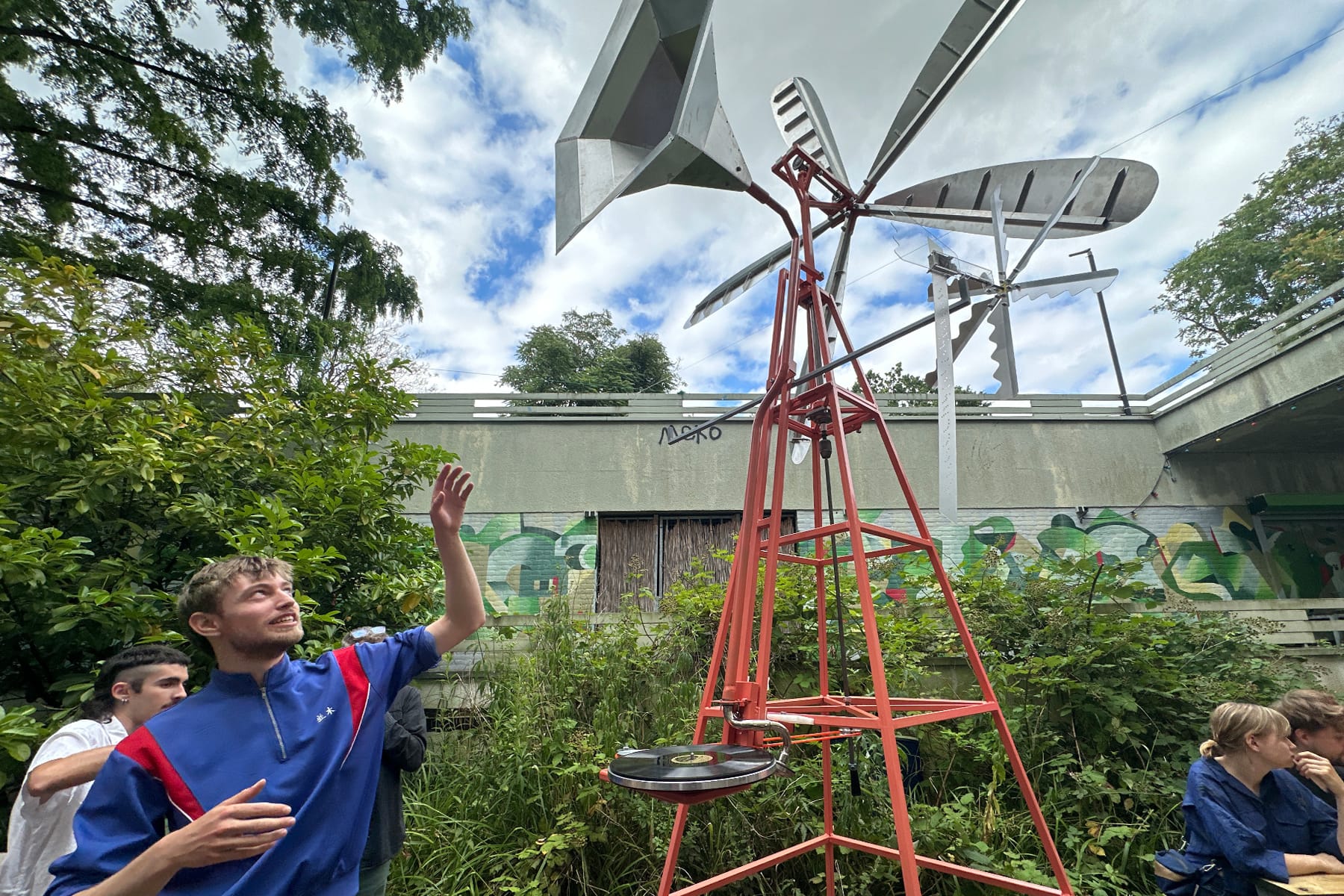
The same is true of Kim van der Sman’s work; he has built various windmills that translate wind into music. Through this poetic approach, he aims to draw attention to the wind and, as he puts it, “living to the rhythm of the wind.” According to Kim, we should view the energy transition as a social and cultural shift that calls for us to reflect on our energy consumption. Kim illustrates this in an educational way, with a massive installation that gives the wind a sound by playing an LP as the windmill’s blades turn. He sees the work itself as a conversation starter, through which people can reflect on their own relationship with the wind.


In addition to the striking focus on observation and slowness in the graduation projects, it is also notable that a quarter of this Product Design class graduated with a focus on footwear. To me, this also shows that, while the designers are a product of their time and reflect their environment and society, they are also a product of the department itself. The designers graduating from a program are shaped by the resources available to them (at ArtEZ, for example, a footwear minor and a specialized workshop). The type of work produced is partly shaped by the resources a program offers and the practical facilities available in the workshops.


In addition, graduates are also shaped by the program itself, the assignments they’ve received over the past four years, and the instructors who have guided the creators throughout this process. Perhaps that is precisely why the work presented at the ArtEZ graduation show feels so familiar to me. After all, I, too, am a product of it. It feels familiar, and it’s nice to walk around here. This sense of familiarity does leave me with a question, though: how much innovation is there in the new cohorts that graduate from the program each year?
Every graduate is not only a unique designer with their own ideas but also a product of the program. This is reflected in the materials, but also in the ideas that are presented, ideas that may have already surfaced in a different form. One thing is clear, though: these designers are ready; their work and concepts are of high quality, and their narratives hold up. Where will we see them next? Perhaps the tableware at a fine-dining restaurant? Or at a festival with a sound system? In a shoe workshop? In a design store where the objects are sold? Only time will tell.
Photography: Anne Pieterse


