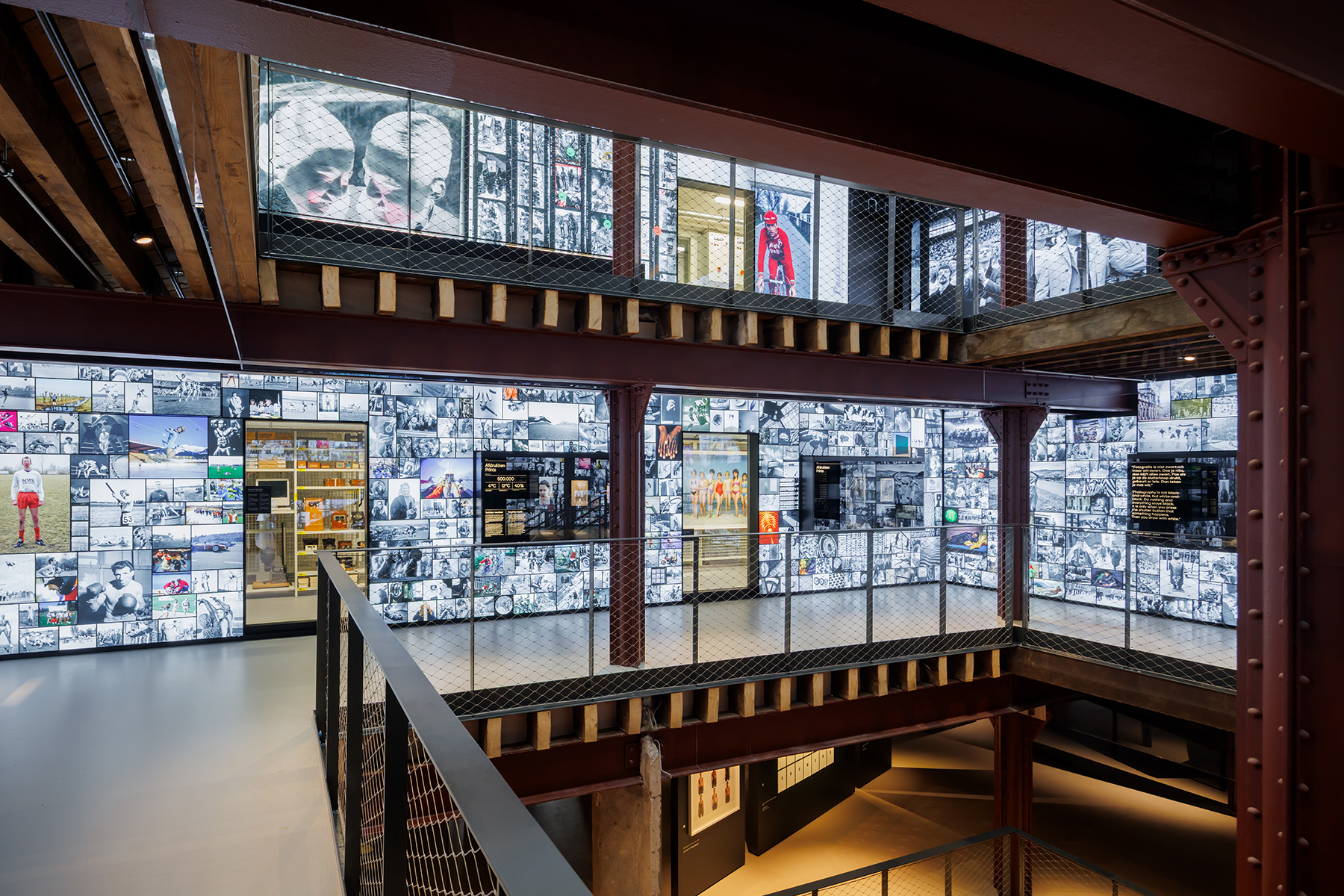
The Nederlands Fotomuseum reopened on 7 February 2026 in the Santos building, a newly renovated historic landmark in the heart of Rotterdam’s dock area. The building will provide a new state-of-the-art home for the national collection of over 6.5 million objects – one of the largest museum collections of photography in the world.
The museum was founded in 2003 following a bequest by Hein Wertheimer, a passionate amateur photographer who left 22 million Guilders (11.2 million Euros) to establish a museum for Dutch photography. The Nederlands Fotomuseum is one of 30 national museums in the Netherlands. Other national museums include the Rijksmuseum and the Van Gogh Museum.

The move to the Santos warehouse
The move to the newly renovated Santos warehouse enables the museum to make its world-class collection more accessible. The museum will be a place of discovery and offer a new way for visitors to experience the art and technique of photography, how it is made and why it matters.
The monumental nine-storey building will include extensive exhibition spaces, a photography bookshop and library open to everyone, educational studios, community spaces, a museum café, a darkroom, and a rooftop restaurant with panoramic views of the Rotterdam skyline.


At the core of the building, a suite of new climate-controlled facilities will house the museum’s collection and conservation centre. Glass walls will allow visitors to observe the collection and atelier spaces, with specialists working behind the scenes in areas such as restoration and conservation.
The acquisition of the new building fulfils the Nederlands Fotomuseum’s longstanding commitment to developing a dynamic meeting place that is open to all and an international platform for Dutch photography. It has been made possible by a donation from the Droom en Daad Foundation.


A global leader in photographic collection management
The Nederlands Fotomuseum is a global leader in photographic collection management and the protection of photographic archives. The work of the museum, including its exhibitions and public programme, centres around its collection, which is an ever-growing record of Dutch photographic history. The museum has amassed a unique collection over more than 25 years. It is estimated the collection will reach 7.5 million images by 2028.
The extensive collection covers Dutch photography, namely works by photographers residing and working in the Netherlands, with a focus on 20th-century analogue and documentary photography. The collection also includes contemporary photographic works, such as Jaya Pelupessy’s The Studio Sculptures and Anouk Kruithof’s installation Neutral (open hearted).


What sets the collection apart?
Setting the collection apart are more than 175 photography archives, including renowned Dutch photographers Ed van der Elsken, Cas Oorthuys and Esther Kroon, along with a vast quantity of negatives and slides. Notably, the collection also includes exceptional photography from the Netherlands’ former colonies, such as the work of Kassian Céphas, who photographed at the court of the sultan of Yogyakarta in the late 19th century, and Augusta Curiel, who operated a photography studio in Suriname a century ago.
Photography is an incredibly fragile medium and the crucial preservation of the photographic heritage of the Netherlands, from the earliest daguerreotype dated 1842 to contemporary digital prints, is a task the museum will share with visitors through the now visible storerooms and dedicated workshops. Visitors will learn about the national collection, the specialised climate, new acquisitions and the variety of objects the museum is responsible for such as negatives, prints, albums and cameras.


The Gallery of Honour of Dutch Photography exhibition will be reconfigured for the new building. This collection presents a snapshot of photography in the Netherlands, from the invention of photography around 1839 to the present digital age. Featuring 99 distinctive photographs chosen for their social and artistic impact, the exhibition includes masterpieces by Anton Corbijn, Dana Lixenberg, Violette Cornelius, Paul Huf, Rineke Dijkstra and Erwin Olaf. The 100th work on display is chosen by visitors on a rotating basis.


Architecture: Renner Hainke Wirth Zion Architekten en WDJArchitecten
Interior: WDJArchitecten, Rotterdam
Exhibition Spaces: Bureau Caspar Conijn, Amsterdam (open depots)
LMNOP, Utrecht (Eregalerij van de Nederlandse Fotografie)
Signage & Visual Identity: LMNOP, Utrecht
Photography: Iwan Baan

