Report by Branko Popovic
While many graduation presentations seek increasingly spectacular venues, the Royal Academy of Art The Hague chose to bring its annual fashion show back to the place where everything begins: the academy itself.
Staged inside Room PC.002, the show unfolded in the very space where students spend years developing ideas, making mistakes, building friendships, and imagining futures. The decision felt less like a production choice and more like a statement. Instead of transporting the work elsewhere, the audience was invited into the environment that shaped it. As the department described it: this is where students create, struggle, connect, care for one another and are allowed to dream.
The show traced a journey through all years of the programme, beginning with first-year investigations and culminating in the graduation collections of Mina Calori, Tim Dekker, Kamila Gałecka, Anahita Karimi, Izzy Monteiro Bühlmeier, Soňa Pichňová and Arthur Wagenaar.
What emerged was a graduation class invested in storytelling and personal mythology. Many of these works began with questions of identity, memory, heritage and belief, translating lived experiences into material form. Presenting the collections within the academy itself reminded visitors that fashion education is not merely about producing garments. It is about creating environments where ideas can be tested, identities can evolve and futures can be imagined.
Worlds Built from Memory
Several graduates drew directly from personal histories and cultural backgrounds, transforming biography into world-building.

Mina Calori’s The Soaring of the Simorgh drew inspiration from Persian mythology and her Iranian heritage. Calori constructed a collection centred on migration, transformation and self-discovery. Ornamental wooden brooches referenced those cherished by her grandmother, while the upholstery of her grandparents’ hotel informed a rich yet understated colour palette.
Bird imagery appeared throughout the collection, most notably in pointed leather shoes resembling beaks. Inspired by the Persian myth of the Simorgh, a legendary bird associated with collective wisdom and self-realisation, the work balanced softness and precision. Woollen surfaces were interrupted by sharp laser-cut interventions, evoking the shedding and renewal associated with moulting. The collection is rooted in family memory while reaching toward universal narratives of becoming.


A similarly autobiographical approach informed Kamila Gałecka’s Izolator Mordy. Looking back at childhood in early-2000s Poland, Gałecka explored the collision between innocence and street culture. References to football fandom and hooligan aesthetics were transformed through colour, humour and unexpected sensuality.
Rather than reproducing the aggression associated with these subcultures, she translated their visual language into something playful and subversive. Symbols of masculinity and confrontation became colourful, almost kinky propositions, creating a collection that simultaneously celebrated and questioned the environments from which it emerged.


Bodies Under Pressure
This was powerfully articulated by Anahita Karimi, recipient of the 2026 Keep an Eye Textile & Fashion Scholarship. Her collection moved beyond fashion into installation and moving image, constructing a meditation on fragility and interdependence.
Throughout the work, horse imagery appeared as a recurring motif. Traditionally associated with power, endurance and nobility, Karimi’s horses were exhausted, burdened and collapsing. Their presence introduced associations with labour, warfare, submission and mortality. Instead of reshaping the body into aspirational forms, the garments followed its anatomy closely, revealing dependence, softness and instability. Seams, skin-like surfaces and distorted silhouettes blurred the distinction between human and animal, confronting viewers with a body that is fundamentally vulnerable.
What made the work resonate was its refusal to frame vulnerability as weakness. Instead, Karimi proposed it as a shared condition connecting all living beings.

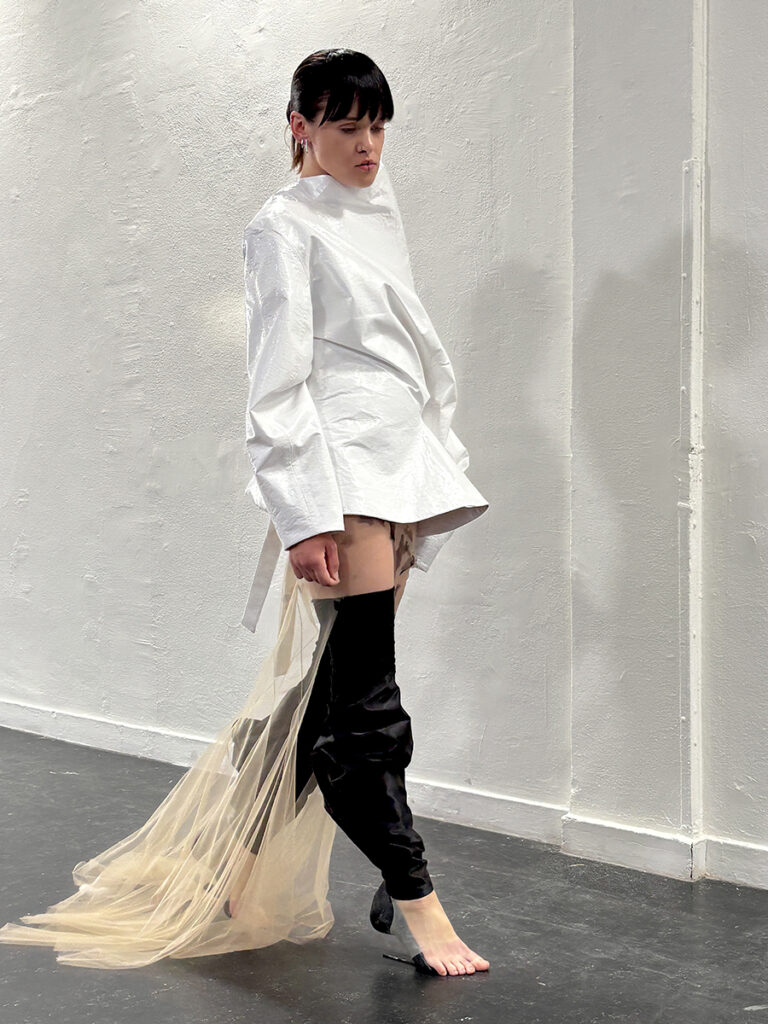
A related investigation into bodily performance appeared in Soňa Pichňová’s collection. Rooted in Slovak cultural references, her work examined femininity not as something innate but as something learned, rehearsed and continually maintained.
Drawing from ballet, Mannerist painting and the distorted photography of André Kertész, she explored how posture, restraint and repetition shape the female body. The resulting silhouettes appeared simultaneously elegant and constrained, exposing femininity as a carefully constructed performance rather than a natural state.


Awkwardness, Community and Freedom
Izzy Monteiro Bühlmeier presented a collection centred on awkwardness. Revisiting moments of discomfort and social uncertainty with affection rather than embarrassment, the designer explored the productive tension between expectation and interpretation.
Through disproportionate silhouettes and the reworking of textiles loaded with pre-existing meanings, awkwardness became a space of possibility. What might once have felt uncomfortable or out of place was reimagined as evidence of discovery.
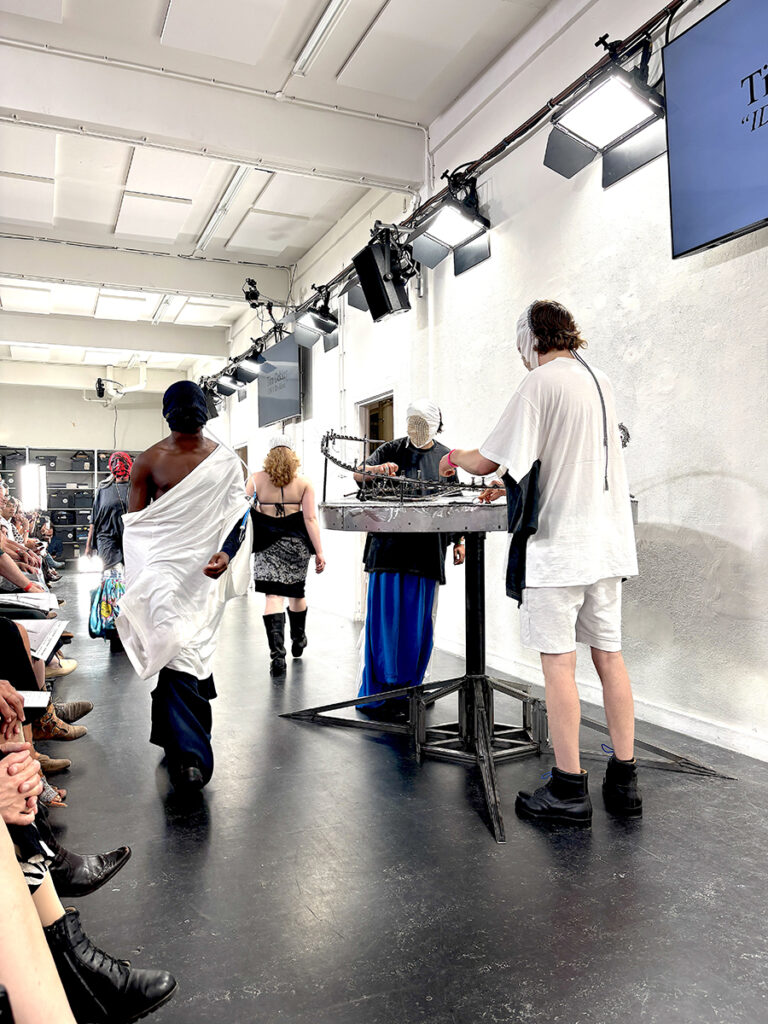
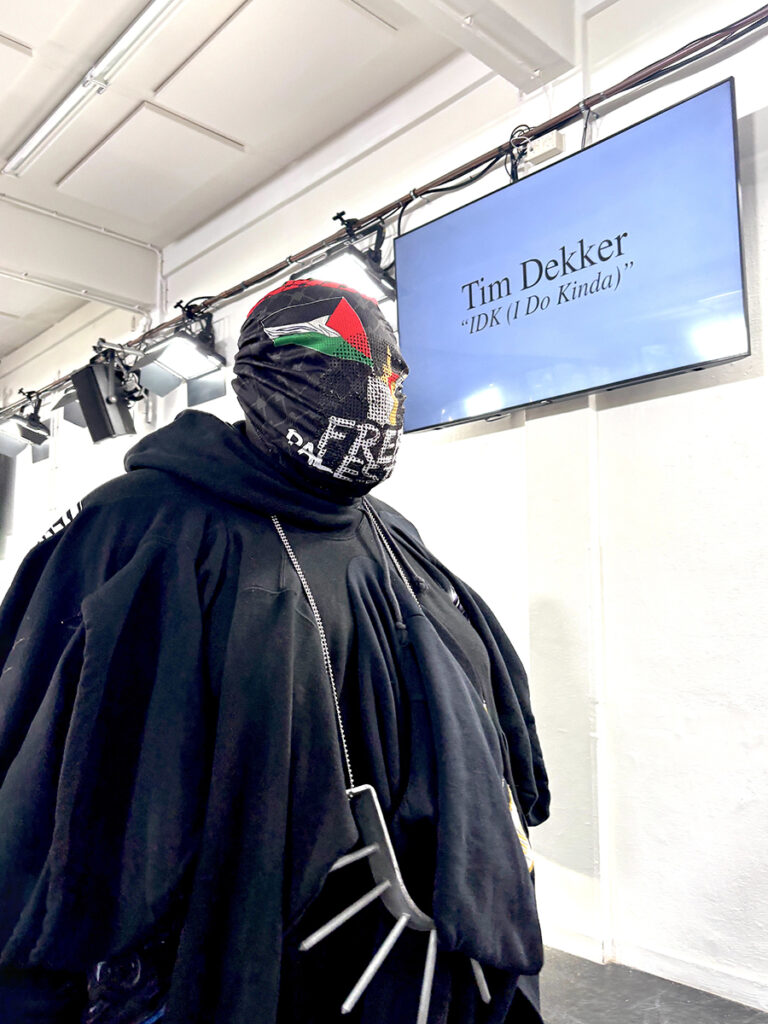


Meanwhile, Tim Dekker approached fashion through sound and collective experience. His presentation revolved around a large self-built musical instrument, constructed through skills he taught himself during the project, including welding.
The performance began with Dekker activating the instrument himself, generating a soundscape that guided the audience into the collection. Rather than functioning as a backdrop, music became the conceptual foundation of the work. For Dekker, music represents a space of freedom, collaboration and shared energy. The collection proposed that fashion might operate in a similar way: not as an individual statement but as a collective practice capable of bringing people together.
The scale of the performance, involving numerous models and performers, reinforced this sense of community and collaboration. It was one of the evening’s most ambitious and momorable productions.


Faith, Labour and Creation
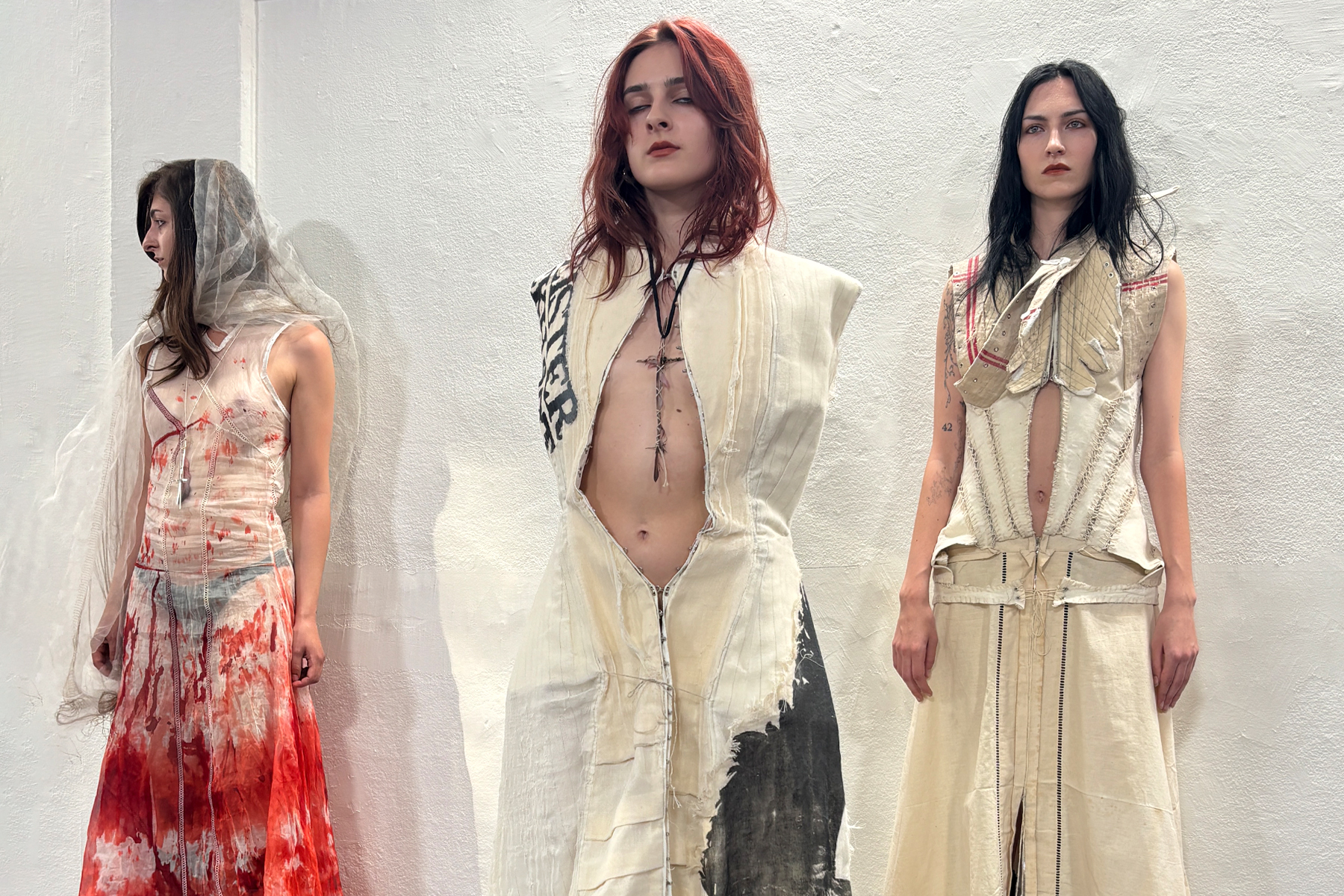
The most philosophically layered collection belonged to Arthur Wagenaar, whose Monnikenwerk (‘Monk’s Work’) connected craftsmanship, spirituality and artistic labour.
Rich in handwork and intricate detailing, the collection drew inspiration from figures such as Simone Weil, Friedrich Nietzsche, Hildegard von Bingen and Titus Brandsma. Wagenaar approached creativity as a process akin to religious devotion: a continuous attempt to translate visions, intuitions and inner experiences into tangible form.
One garment featured a portrait of Titus Brandsma, the Dutch Carmelite priest and philosopher who resisted Nazi ideology and was murdered in Dachau concentration camp in 1942. Through such references, Wagenaar linked personal making processes to broader questions of ethics, belief and perseverance.
His central proposition, that artistic practice resembles the repetitive and dedicated labour of monastic life, highlighted the importance of process, creativity not as sudden inspiration but as ongoing commitment.
Photography: Branko Popovic

