
Longread by Mienke Simon Thomas
Leiden is known as the “cloth city”. This is even recorded in the Canon of Dutch History. Not entirely without reason: cloth production was important a long time ago and ensured that Leiden became the second city of the Netherlands in the late Middle Ages. Yet there are also plenty of reasons to call Leiden a “blanket city”.
Blankets were made in this city from the end of the sixteenth century until the 1970s, when the rise of the duvet brought this industry to an abrupt end. The last Leiden blanket was produced in 1976. Leiden blanket production was particularly important in economic terms in the nineteenth and early twentieth centuries; half of the city’s inhabitants depended on the manufacture of these thick, warm, fluffy wool blankets.
Five years ago, Helga van Manen took the initiative to establish the Leiden Blanket Foundation. This foundation not only aims to draw attention to the historical “Leiden blanket heritage”, but also to produce new Leiden blankets. The processing of wool from the Netherlands – that beautiful, high-quality and recyclable raw material that is still burned in large quantities – is an important motivation for this. For the past four years, an enthusiastic team of volunteers has been weaving blankets again in their steadily expanding workshop in the centre of Leiden. They have translated the traditional manufacturing process of these blankets into a more contemporary, small-scale production method.


In terms of design, during the first three centuries of their production in Leiden, the old Leiden blankets did not go much further than stripes in red, blue, green and yellow. It was not until the end of the nineteenth century that blankets with patterns began to be woven. The Leiden factories called these blankets, which were produced using a modern jacquard machine, “fantasy blankets”. In fact, one must conclude that Leiden blankets have a more interesting history in terms of design than Leiden cloth, which in the past was only available in plain colours.

It is therefore not surprising that Nicole Roepers, curator of actual art at Museum De Lakenhal in Leiden, became interested in a New Leiden Blanket. She had previously initiated the Nieuw Leids Laken (New Leiden Cloth) project, in which renowned artists and designers were asked to create a contemporary design for the woollen fabric. Museum De Lakenhal and the Leiden Cloth Foundation joined forces in 2024. Roepers approached the young graphic designer and creative coder Vera van de Seyp. Born and raised in Leiden, Van de Seyp studied at the KABK in The Hague and then obtained a Master’s degree as a Code Designer at the Massachusetts Institute of Technology (MIT) in Cambridge in the US. She currently lives in New York, where she works as a designer and teacher. As her website shows at a glance, Van de Seyp is entirely dedicated to the use of computers in design.

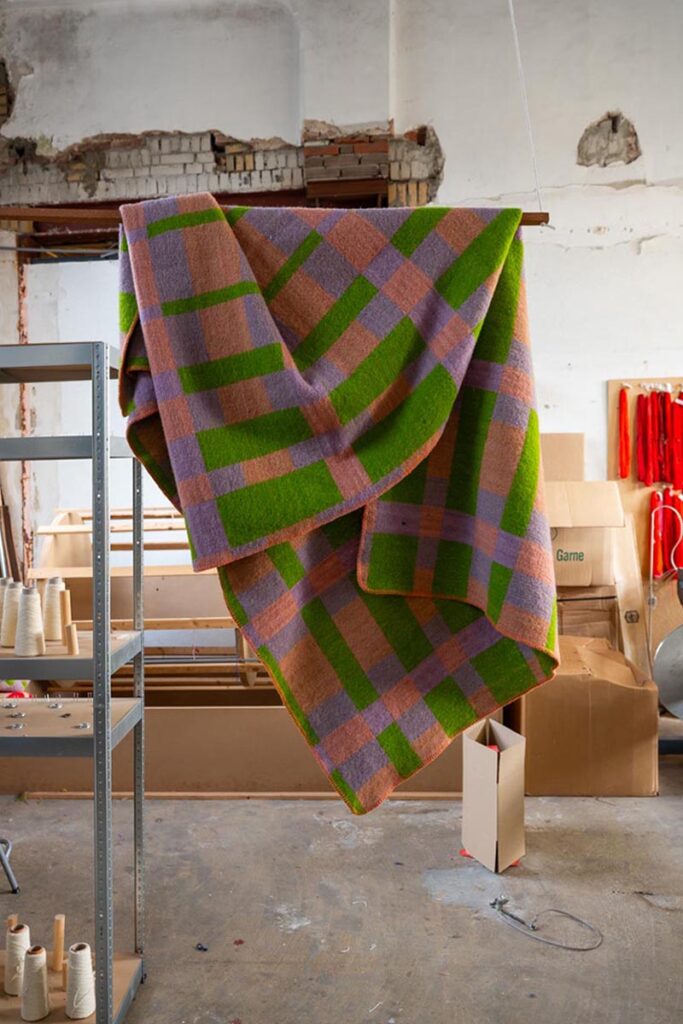


At first glance, Van de Seyp’s ultra-modern computer- and AI-generated designs seem miles away from traditional blanket patterns. However, the possibilities at the traditional Leiden Blanket Workshop were greater than one might initially think. For almost two years, their workshop on Papegaaisbolwerk has had a so-called “bicycle loom” with a limited but interesting possibility to programme it with a simple roller perforated with holes. For Vera van de Seyp, this was enough of a challenge to accept the commission.
In preparation, Van de Seyp immersed herself in the history of blanket manufacturing in Leiden. It turned out that there had been many more factories than the three or four whose remains can still be found in Leiden today, such as Zaalberg, Van Wijk, Scheltema and Zuurdeeg. Vera selected ten in total and, with the help of a system she devised herself, converted the names of these factories into ten digital codes. She combined this digital data with the capabilities of the bicycle loom, resulting in ten patterns that can be produced in the Leidse Deken workshop. These patterns were linked to a palette of ten colours of yarn. The Leidse Deken also provided the preconditions for this: Van de Seyp makes her choice from the 125 colours available in the workshop.

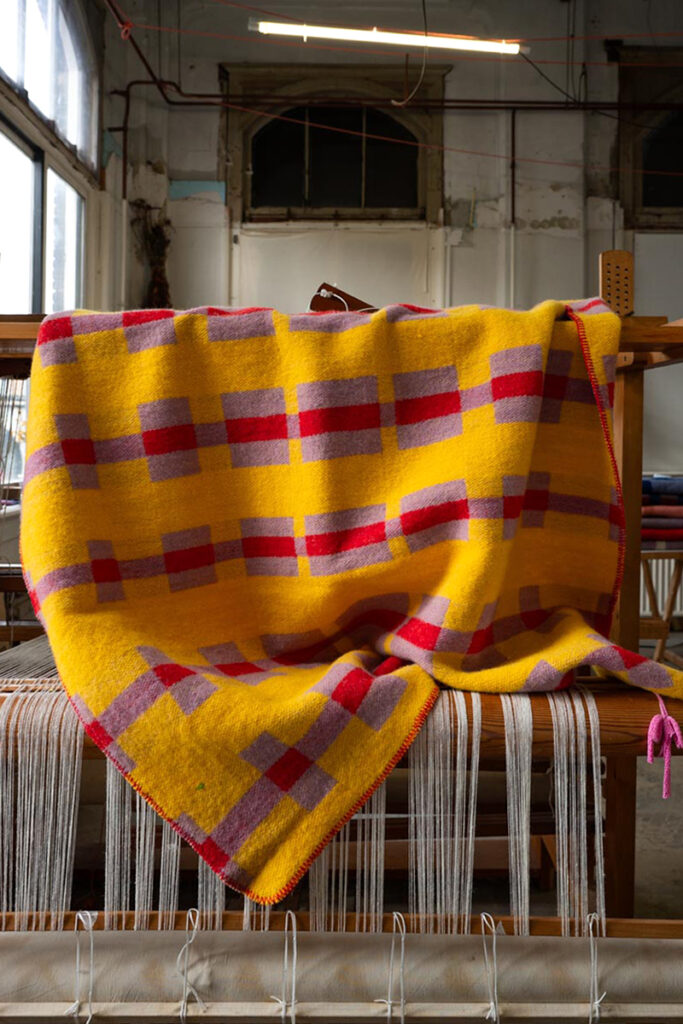
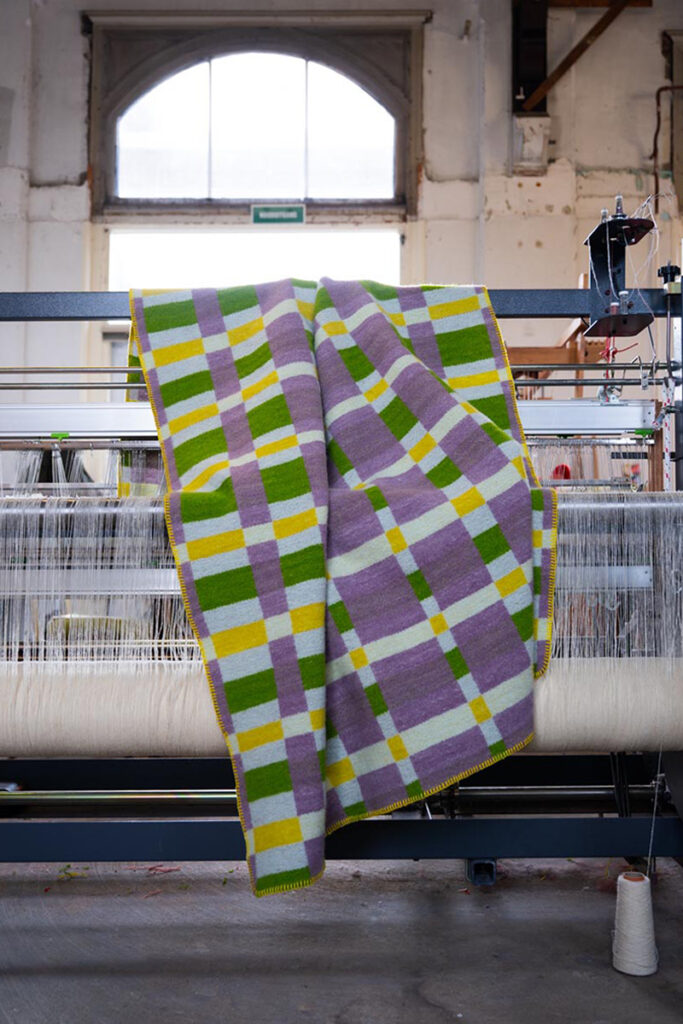
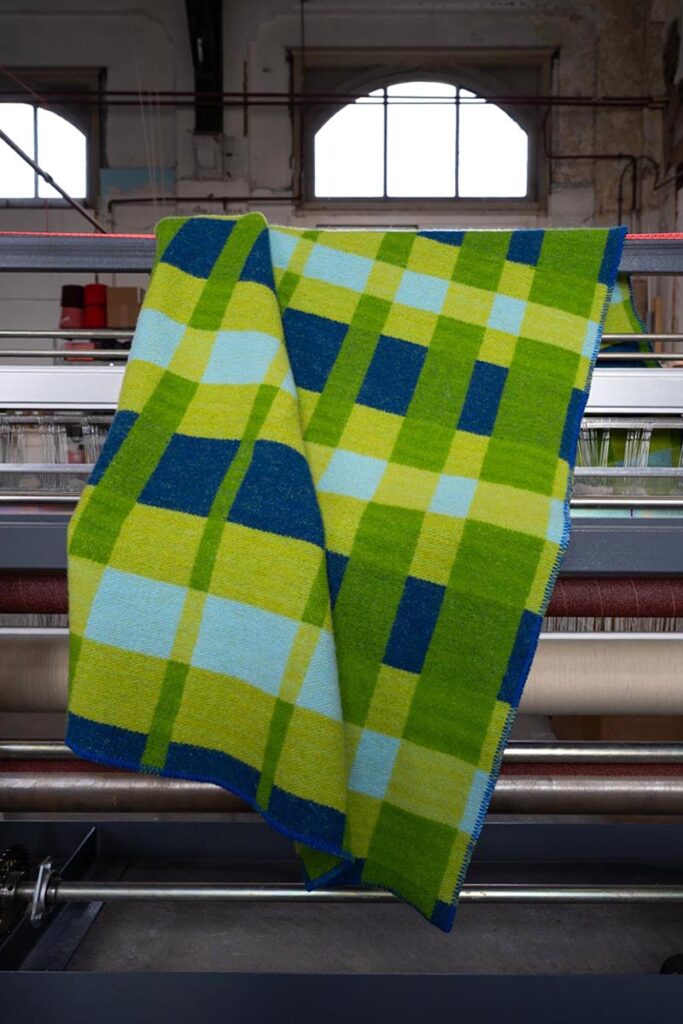


The result is a collection of nine cheerful blankets, each with a different block pattern and named after a former Leiden blanket factory. The blankets are available for purchase in the Museum De Lakenhal shop and in the Leidse Deken shop at Papegaaisbolwerk 18 in Leiden.

