
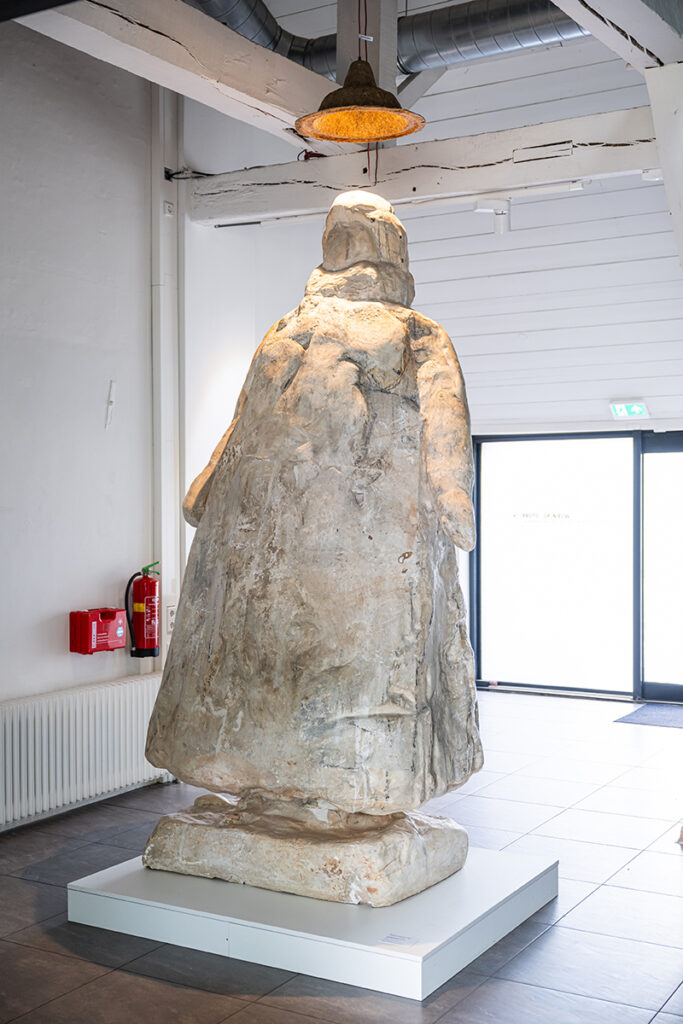
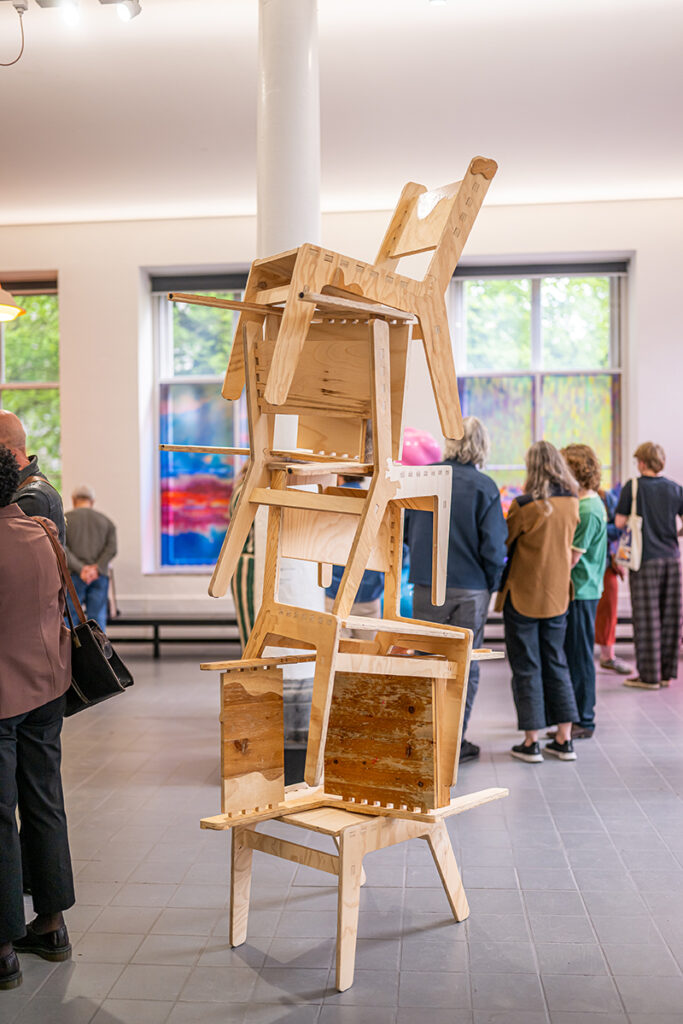
This year, designer Jack Brandsma and visual artist Hester Oerlemans are the artists-in-residence at PROTO, Zwolle’s annual Art & Design Festival. Together with students from various Zwolle-based educational institutions, they have created the exhibition (RE)NEW.
The work of Brandsma and Oerlemans forms the starting point for this exhibition. Both creators often use existing (visual) elements to create new sculptures. With minimal interventions, they are able to transform something existing into a completely new image, often with an alienating effect. Their own work can also be the starting point for a new image. Based on this idea, Brandsma and Oerlemans, together with students, searched for existing objects that could be the starting point for new works for (RE)NEW.


From the start of the project, Brandsma and Oerlemans, together with the students, also took the space of their exhibition as a starting point. After all, a space can also be seen as an existing image; what interventions are needed to change its meaning? How do you make a space your own? Here, the creators respond with stacked columns on the pillars in the center of the Garden Room, and the foils on the window refer to, among other things, a work from the collection of Museum de Fundatie, Rij van elf populieren in rood, geel, blauw en groen (Row of Eleven Poplars in Red, Yellow, Blue, and Green) by Piet Mondrian.




Jack Brandsma
For Jack Brandsma, the material is always the starting point when creating his designs. In recent years, he has been wondering whether working with plastic is still future-proof. In his latest works, he is therefore increasingly exploring possibilities for working with other, more natural materials. These include bio-plastics, but also hemp fibers and potato starch.
In (RE)NEW, Brandsma demonstrates how he almost always builds on his own previous ideas and existing designs. For example, he has been working on his Major Tom Family lamps for more than twenty years. This series originated in 2003, when Brandsma designed a new interior for the media library of the Minerva Academy. He created an interpretation of the enameled industrial lamps that were already hanging there. To do this, he added a rim to the original design, among other things. Since then, he has reinterpreted the lamp many times. One of the latest versions of Major Tom, in line with Brandsma’s fascination with new materials, is made of PLA bioplastic, potato starch, and miscanthus fibers.
Interior architect and product designer Jack Brandsma (1969) studied at the Royal College of Art in London, where he obtained his master’s degree in Design Products in 2001. In 1997, he obtained his bachelor’s degree in Interior Architecture at the Minerva Academy in Groningen.




Hester Oerlemans
With her multifaceted work, Hester Oerlemans responds to her surroundings with a poetic, but sometimes also critical, gaze. In (OP)NEW, she presents various works based on repetitions, accumulations, and existing visual elements. For example, The Fish Curtain refers to a painting by René Daniels, Hollandse Nieuwe ontdekt hoe Hollandse Nieuwe smaakt (Hollandse Nieuwe discovers how Hollandse Nieuwe tastes), from 1982. In Daniels’ work, the fish eat each other, based on the idea that if the fish knew how delicious they were, they would all eat each other and we would be left with nothing. Oerlemans plays with this idea by stringing together fish bait in all colors and shapes to form a curtain. In this way, she gives an existing idea a new meaning and asks the question: who is bait and who is hunter?
Oerlemans manages to give everyday objects a new lease of life by enlarging them, distorting them, or combining them in new ways. Hang it all, for example, is an enlargement of the coat rack of the same name by the famous designer duo Charles & Ray Eames from 1953. SEAT is the seat of a canteen chair, which Oerlemans has folded in half by heating it. The association with Donald Duck’s beak is quickly made.
Dutch artist Hester Oerlemans (1961) has been living and working in Berlin for more than twenty years. Her drawings, paintings, and installations make the familiar seem unusual.
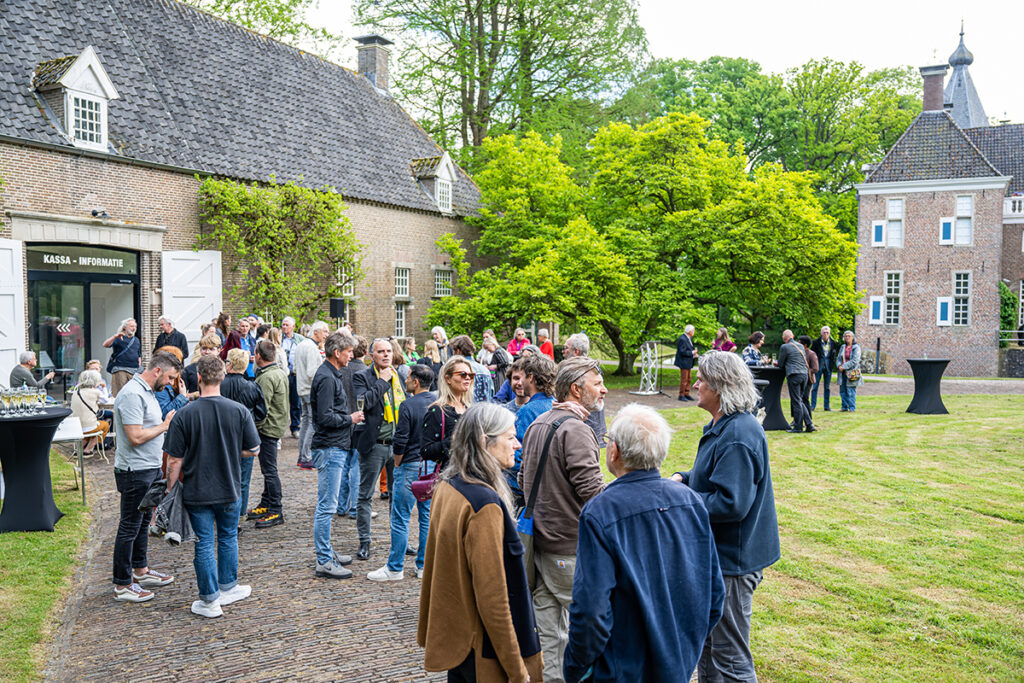
(RE)NEW: Jack Brandsma, Hester Oerlemans & Students
Museum De Fundatie, Kasteel Het Nijenhuis
Heino/Wijhe
Until 21 September, 2025
museumdefundatie.nl
Photography: Peter Tijhuis, Kasper Veenstra (opening exhibition)
