On International Women’s Day, a day when we reflect on the position, voice and autonomy of women worldwide, Nomi takes centre stage. Nomi is an impactful design initiative that combines care and thoughtful design to make gynaecological examinations more personal, safer and more respectful. It shows how design can not only improve systems, but also restore trust, thereby opening up new perspectives for an inclusive future.
Nomi is an initiative of social design agency Afdeling Buitengewone Zaken, in collaboration with social researcher Françoise Molenaar and creative agency Multitude. We are working on a new standard for internal examinations that is more personal, safer, and more respectful for patients and healthcare providers.
A Pap smear may take three minutes. But for many people, it is a moment when they literally and figuratively open themselves up. Vulnerable, in a space where they have little control. Not because healthcare providers are not doing their job properly. But because the conversation surrounding it often remains implicit. Consent is not the same as safety. Not saying no is not the same as saying yes.
“I felt overwhelmed, but I said yes anyway” – Laura, patient (26)
Nomi design research
Dutch scientific research among nearly 1,500 women (Molenaar and Huijskes, forthcoming) shows that:
45% find internal examinations painful.
41% feel embarrassed.
23% even describe it as traumatic.
However, you often don’t hear this from your patient: one in three women find it difficult to set boundaries during the examination.
We investigated what really happens during internal examinations. Not just the medical procedure itself, but everything surrounding it. How is the conversation conducted? How are expectations aligned? How are control and consent put into practice? We co-created with patients, trainers, and healthcare providers. We reflected our insights back in sessions with medical experts. We tested, adjusted, and listened again.
Because an internal examination sometimes touches on more than just the body. It can touch on a history of sexual trauma. On a previous unpleasant experience with a doctor. On shame, tension, or the feeling of having no choice. That is precisely where conversation and coordination are needed.
New standard
How we shape that moment, in words, pace, and coordination, determines how care is experienced. We believe that coordination is not an extra step. It is the basis of good care. Not as a protocol or obligation, but as professional sensitivity: taking a moment to consider who is sitting in front of you before you begin.
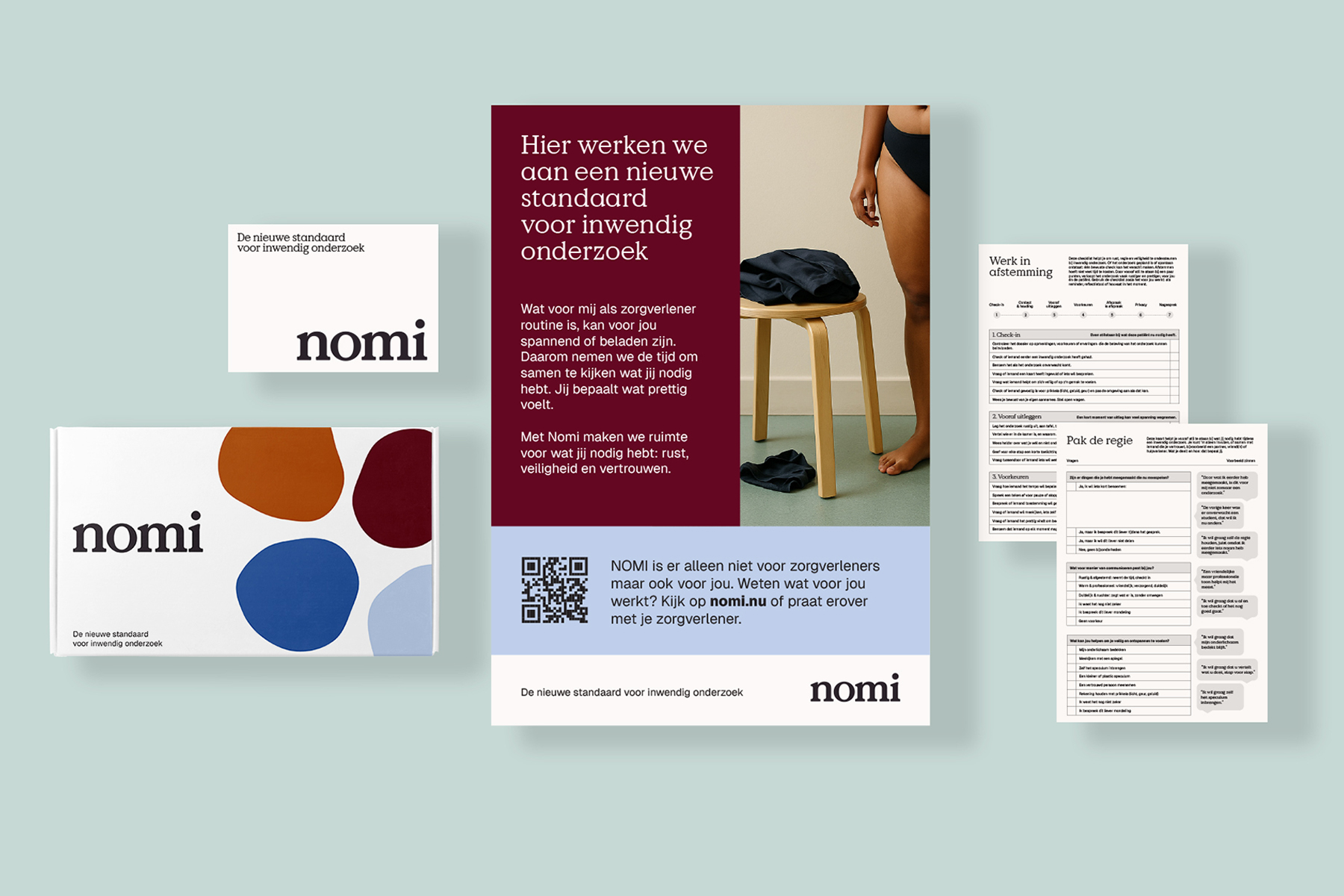
We believe that patients have the right to be in control, including in the consultation room. And that healthcare providers deserve the space to have that conversation without it being at the expense of their time. That is why, in September 2025, we launched the ‘Even if you don’t hear anything’ campaign and the Nomi package.
The result is a free package of three tools. No protocol. Just an invitation to make explicit what otherwise remains implicit. Because boundaries are too often not discussed. Good care does not stop at the act itself. With small adjustments, Nomi makes a big difference, without you having to change your working methods.
The control card helps patients think in advance about what is important to them: explanations, breaks, preferences regarding posture or pace.
The checklist for healthcare providers is a practical reminder for every examination: consciously consider coordination, communication, and trust.
The waiting room poster is a visual invitation to reflect, even before the examination. For patients, it is an incentive to think about what they need. For healthcare providers, it is a subtle reminder to be attentive and responsive.
The Nomi package is available free of charge at nomi.nu. Because we make change in healthcare together.
Nomi is for everyone who uses women’s healthcare. We use the term “women” for readability, but we mean women, trans, and non-binary people with a uterus and/or vulva. We strive for inclusivity in our approach.