Longread by Marjan Thielen
Just outside Eindhoven, in the countryside around Oirschot, lies Nieuw Zwanenburg, a field lab where agriculture, design, and innovation are actively intertwined. What grows here is more than just crops. It is a way of thinking. A way of creating. And perhaps even a tentative blueprint for how we will interact with our environment in the future.
Nieuw Zwanenburg serves as a workshop where the entire chain from seed to application is made visible and tangible. Fiber crops such as hemp, flax, elephant grass, and sorghum grow in the fields. These crops not only contribute to healthier soil life but also serve as raw materials for research and development. In close collaboration with Rijkswaterstaat, one of the key partners, work is being done here to address the question of how we can redesign our infrastructure: to be less burdensome and more in balance with the environment. What is harvested here does not disappear anonymously into an industrial process, but is researched and processed into concrete applications within civil engineering.
That’s what makes this place special. Here you can see how fields of fiber crops are transformed into, for example, a lamppost or a biobased traffic sign along the A58.

Nieuw Zwanenburg is not purely a technical or agricultural environment. It is precisely the combination with design that makes the difference. Designers are invited to take a fresh look at materials, not just as a solution, but as a starting point. What else could a material be? What applications lie beyond our current frame of reference?
This room for experimentation gives rise to surprising projects and new perspectives. For example, the ZachtZicht noise barrier was developed in collaboration with Rijkswaterstaat and Natrufied Architecture: it is entirely biobased, made from crops grown in the field, and designed to serve both as a noise barrier and as a habitat for plants and animals. A prototype is currently on display at the Nieuw Zwanenburg site.
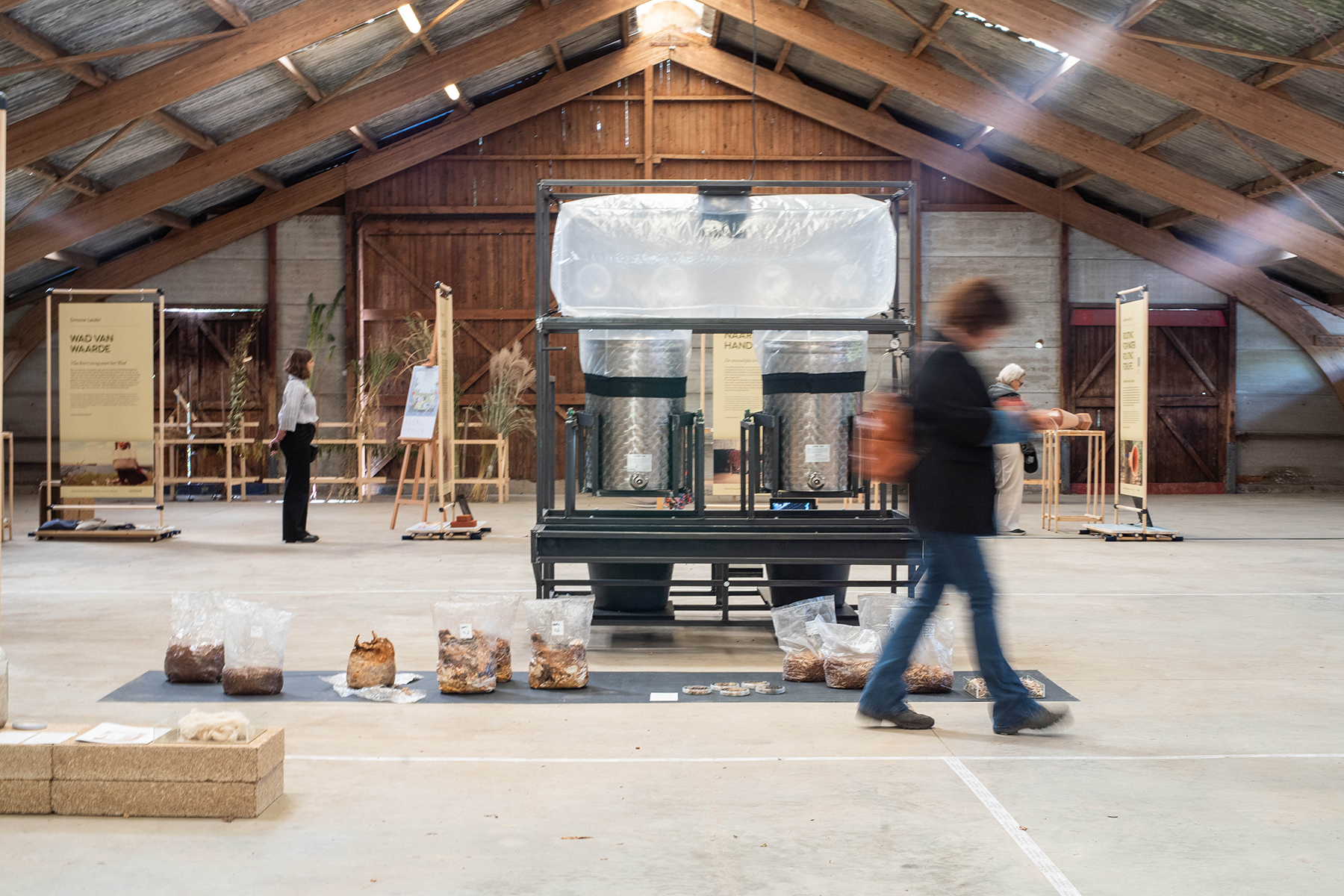
The country’s agricultural output is also being utilized at the biochemical level. Designer Tjeerd Veenhoven is investigating how dried hemp can be fermented with mycelium to extract the lignin from the plant. This could serve as a plant-based alternative to bitumen in asphalt. Although the project is still in development, it shows great promise. Even a partial replacement would represent a major step forward for the road construction of the future.


Under the canopy, work is underway on an entirely different scale. Thanks to OpZUID, Jelle Feringa is developing a robot capable of constructing sound barriers on-site using soil. The design has been certified by ProRail and has a footprint that is just 10% of the standard. It’s a fascinating example of how technology and bio-based construction come together.

A project like Marjan Thielen’s Bodemwijsheden brings this way of working to light in a more poetic manner. In this experiment, cotton napkins were buried at various locations throughout the Netherlands and later dug up again. What became apparent was not only the decay of the material, but above all the work of the soil itself. Sometimes hardly anything had changed; sometimes the napkin had virtually disappeared. The result cannot be controlled or explained and calls for observation rather than control. It makes us feel that what happens beyond our sight is also of great significance.


That open-minded approach runs like a common thread through everything that happens at Nieuw Zwanenburg. It is a place where nothing is set in stone, where there is room for experimentation, and where failure can be just as valuable as success. It is precisely through that exploration that new knowledge emerges—knowledge that we are eager to share, whether with partners or during open houses, meetings, and events, when the site is literally opened up to the public. Visitors can then walk among the crops, view exhibitions, talk with designers and researchers, and experience how abstract themes such as sustainability and circularity are brought to life.
What Nieuw Zwanenburg ultimately demonstrates is that the transition to a biobased and regenerative way of working is not only a technical challenge, but also a cultural one. It calls for different narratives, different images, and a different way of looking at things. By connecting agriculture, design, and technology, space is created for these new perspectives.
Perhaps that is this place’s greatest strength: that it not only develops solutions but also fuels the imagination. And in doing so, it raises the question of how we want to build, live, and work together in a world that increasingly calls for balance with what already exists.


Open House
Nieuw Zwanenburg, Oirschot
8 – 9 May, 2026
nieuwzwanenburg.nl/program
Photography: Sean Fisher


