
Opinion by Jeroen van Erp
For two years now, it’s been the buzzword in the design world: AI, or artificial intelligence. The big question is how designers – in the broadest sense of the word – should relate, or come to relate, to these developments. And to start with the conclusion of this piece: AI helps you design, but it doesn’t make you a better designer.
AI?
Perhaps we should first go back to basics: what exactly is AI? It’s strange that this question is rarely asked in the many publications that have appeared on the subject. In 2019, Andreas Kaplan and Michael Haenlein proposed a definition that has since gained widespread acceptance:
Artificial intelligence is a system’s ability to correctly interpret external data, learn from that data, and use those lessons to achieve specific goals and perform specific tasks through flexible adaptation.
The three aspects that capture the essence are, first of all, the ability to interpret – that is, to draw conclusions from data – to learn from this, and for the system to adapt its behavior based on these insights. The term “AI” is now used indiscriminately, but with the above in mind, it should be clear that a great many things are not AI-driven, even though that is often suggested. My hybrid car, my Ziggo box, and my phone are indeed smart, but they are not learning systems. At least, not yet.
The Impact of AI
Let’s return for a moment to the implications of AI. Given all the tools available, it’s clear that this development will have a major impact on how we practice our professions as designers, architects, fashion designers, or game designers. AI helps speed up tasks, for example by rapidly generating a large number of alternative solutions or by improving the quality of presentations. In just two years, prompting has become an indispensable skill for designers. You’d have to have been living under a rock or be highly tech-agnostic not to see this.
But also: AI always looks to the past, reorganizes that knowledge, is barely aware of a future context, and, as far as we can tell at this point, has no opinion or value system as a foundation.
However, there is another aspect that may have an even greater impact on what we, as designers, need to do: the impact of AI on the world. We’ve seen that the digital revolution, starting around the mid-1990s, has drastically changed the world. We can, in fact, view developments in AI as an extension of this. How do we deal with the fact that, in the blink of an eye, our clients have already come up with a solution to a problem using AI – one they’re very enthusiastic about because, in their eyes, it solves the puzzle and looks pretty good? How do we deal with the fact that agents – AI search robots capable of independently analyzing, taking action, and making decisions, such as Google’s Gemini – are shaking up the world of brands, communication, and products? It’s a movement whose consequences are not yet fully clear, but it’s crystal clear that things are shifting for our clients.
Our Value Proposition
But what if many of our original tasks and skills are taken over by AI? Over the past few decades, we’ve seen how software has made traditional design work easier – don’t forget that, until roughly the mid-1990s, we were still doing everything by hand. We still needed those artisans to create illustrations, write code, or produce 3D renders and animations – but now with the help of software. These tasks will largely be handled by AI, whether we like it or not.
The question we as a design community must answer is: what is our added value in this AI-driven world? Within the realm of design lies disciplinary thinking, which in turn is rooted in the artisanal mindset – the very aspect of the profession that, as we’ve just noted, AI is set to turn upside down. Browse through academies and universities, and under the heading “programs,” you’ll see graphic design, animation, product design, photography, fashion, interior design, architecture, and even more practice-oriented bachelor’s and master’s degrees. Apparently, it’s difficult to break free from thinking in terms of “designers as tools.” But if we zoom out and look at that wide range of designers, what are the commonalities, and what is the core?
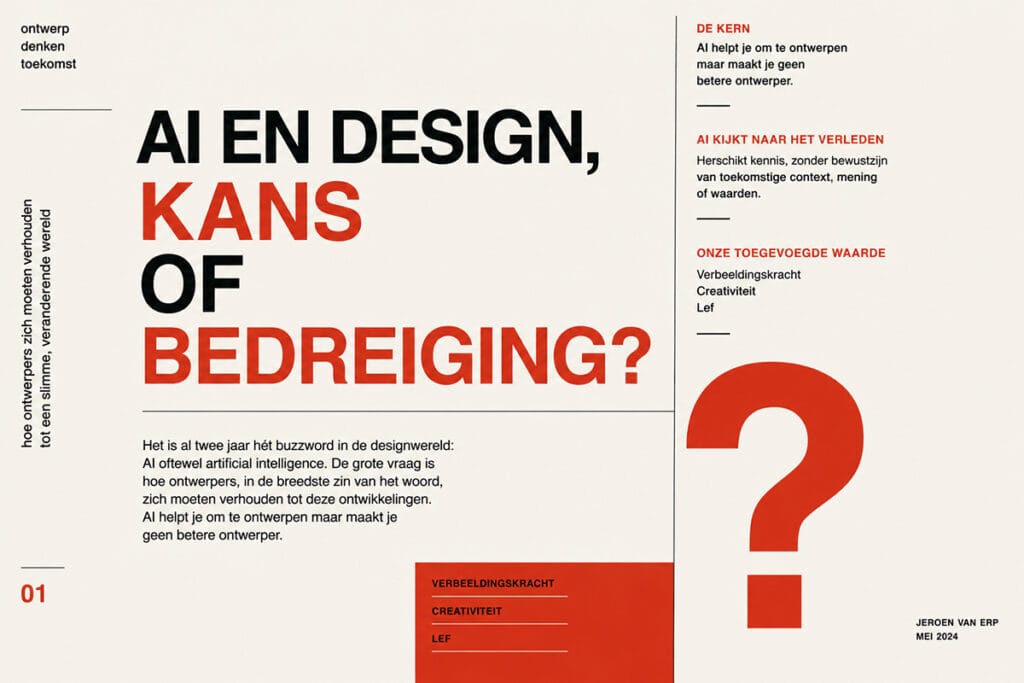
Competencies
I believe that designers possess three competencies that we must cherish. First, imagination: we are able to envision a different reality, a different future with different products and services. In doing so, we are happy to stray from the beaten path, using our creativity to develop concepts that both make a difference from a user or societal perspective and serve our clients’ goals. And to achieve all of this, a third essential personal quality is needed: courage! We are not afraid to stray from the beaten path.
So when we look at these core competencies, it’s reassuring to note that, for now, AI lacks all three to a certain extent. AI’s imagination is minimal, its creativity is deceptive (namely, superficial), and it lacks guts. Of course, to bring concepts to life, we’ll also need specific skills such as creating (technical) drawings, illustrating, or coding – but that’s exactly where we can put AI to work.
And then there’s one more thing: the world is becoming more complex by the day and cries out for design power. At the same time, briefings are becoming less and less straightforward. More and more clients present a problem rather than a briefing. Even major societal challenges don’t have a ready-made path to a solution. We have no choice but to transform ourselves from designers of means into designers of ends. And as it happens, the three core competencies mentioned earlier are ideally suited for this. It’s also a good opportunity to take a critical look at how we’ve structured our education system – and, incidentally, this is a matter of some urgency.
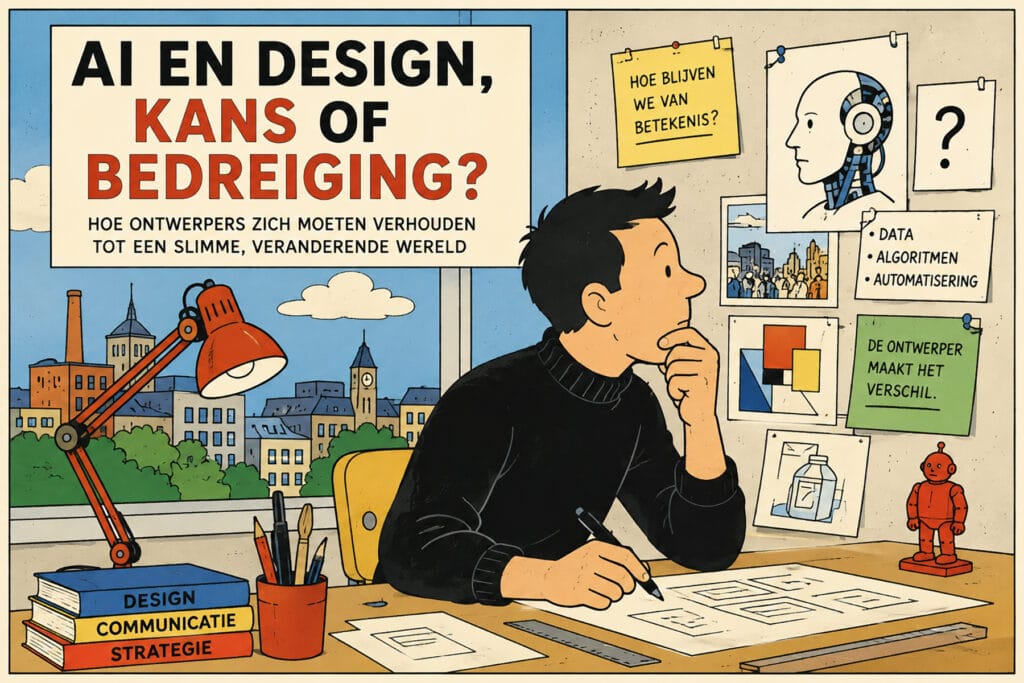
The Core
I already gave it away in the introduction: AI helps you design, but it doesn’t make you a better designer. Technological developments – and AI is practically the epitome of this – are actually forcing us to return to the core of what makes us meaningful as designers: imagination, creativity, and courage. So while there are plenty of opportunities in this rapidly changing world, we also need to take a look at ourselves, our educational programs, and the story we tell. Let’s show some courage!
Images created by Jeroen van Erp with ChatGPT


