Report by Niek Schoenmakers
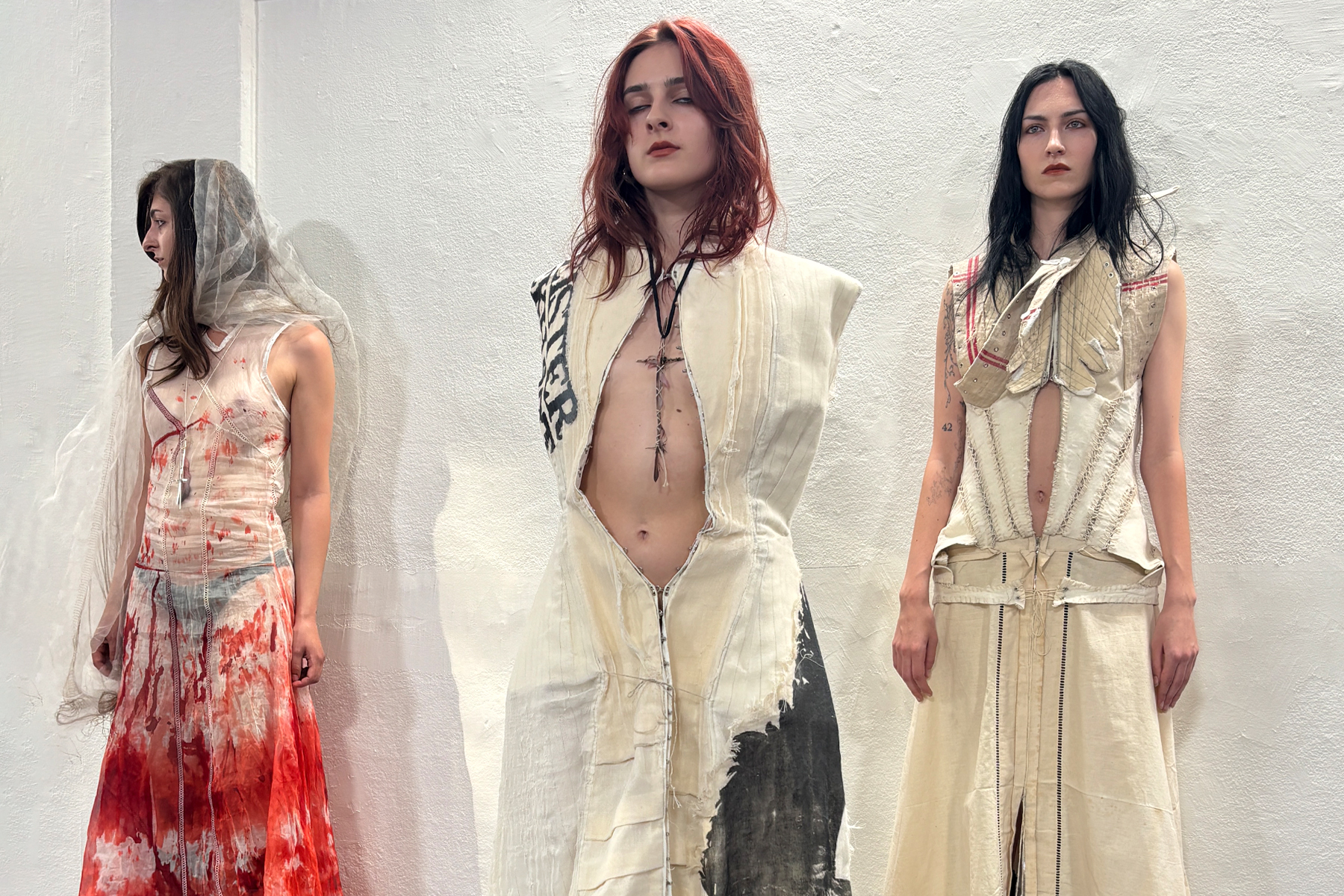
From June 10 to 14, the Sandberg Instituut presented the Graduation Show 2026. Spread across various locations in Amsterdam, students from programs including Design, Fine Arts, Studio for Immediate Spaces, and the Dirty Art Department showcased the results of their master’s research.
During a visit to the graduation presentations of Studio for Immediate Spaces (SIS) and the Design Department (DD), it was striking how various projects navigated the space between fixed categories. The focus was not on the endpoint, but rather on the transition: between damage and ornament, between waste and raw material, between animal and legal entity, between student and professional.
Studio for Immediate Spaces
The students of Studio for Immediate Spaces presented their work on the tenth floor of the former Slotervaart Hospital. The building, which previously hosted the BIGart art fair, is still in a state of transition and provides a fitting context for a department that explores how space influences our thoughts and actions. The unfinished walls, concrete passageways, and screw holes do not serve as mere decor, but as an active part of the presentation.
A Slip of Space
In A Slip of Space, architect Rosa Shepherd explores the act of slipping as a state between two positions: a moment when something exists between departure and arrival, between support and loss of footing.
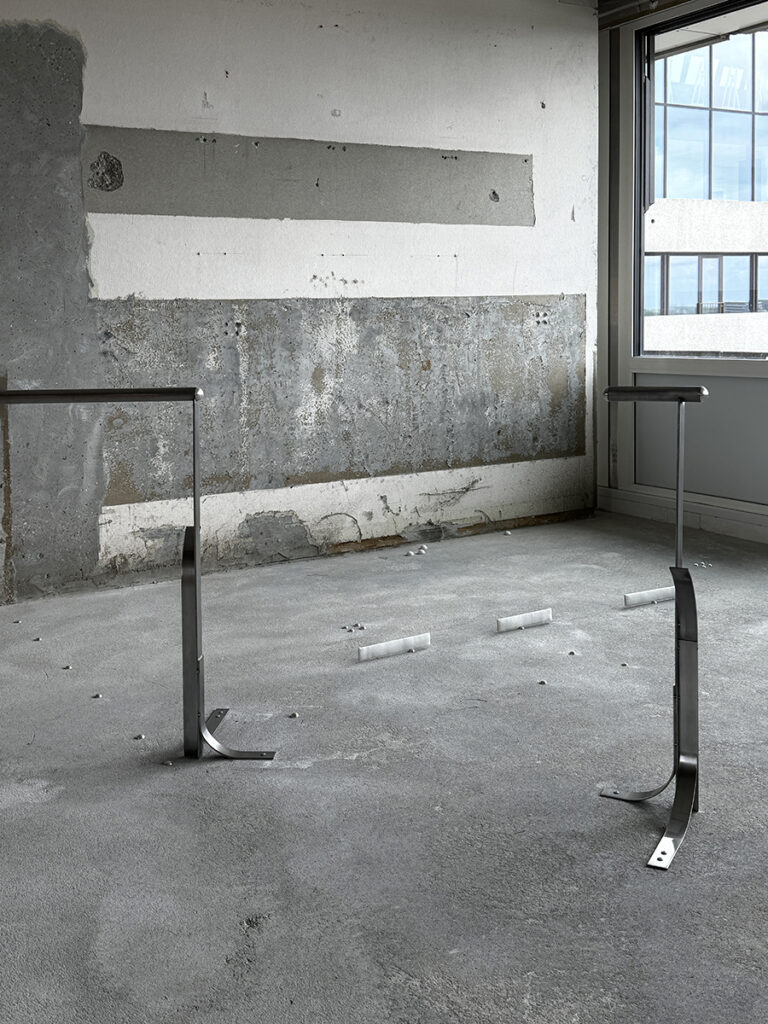

At the heart of the installation are stainless steel handrails that seem to be losing their familiar function. Where a handrail normally provides support, Shepherd’s elements appear to be slipping away from their anchors. Fixation and movement coexist. The work thus literally occupies a space between function and disruption. For her research, Shepherd focuses on traces of use: the often-unnoticed remnants of human presence in a building. Years of use have left screw holes, dowels, pencil marks, and damage in the former hospital rooms. Shepherd replicates these traces one-to-one onto the floor. Where a hole once was, a small intervention appears—a raised dot. The small dots are reminiscent of the tactile markings used in public spaces to guide the visually impaired, now rendered in aluminum, porcelain, or silk. The choice of silk is no accident. It refers to the slip as an undergarment: a garment that normally remains hidden, yet is an essential presence. In this way, Shepherd shifts the focus from the visible to the hidden. The installation also evokes an interesting tension between damage (masculine) and ornament (feminine). A drill hole, scratch, or dent carries something violent within it, while an ornament is associated with decoration and refinement. Shepherd brings these two worlds together. The installation demonstrates how architecture is shaped not only by design but also by use. The focus is not on the perfect drawing, but on becoming aware of our own place within that space.
Looking For What Is Left
While Shepherd focuses on the traces users leave behind in architecture, Patrick Bosman explores the scars left by material extraction itself. The designer presents a series of objects that are instantly recognizable to anyone who has ever visited a construction site: a support column, a shovel, a crowd barrier, and a transport trolley. For the structural elements, however, Bosman uses found fragments of marble. The result is an intriguing sense of alienation.


Marble has traditionally been associated with monumental architecture, power, and prestige. From classical antiquity to contemporary luxury interiors, the material is regarded as a symbol of beauty and status. At the same time, it is a natural resource extracted from the landscape through invasive mining processes. In Looking For What Is Left, Bosman shifts the focus from the finished end product to the material itself. The marble fragments are barely processed and retain their cracks, chipped corners, and signs of wear. By combining them with everyday objects from the construction world, they lose their self-evident nature and functional purpose. The objects seem to exist somewhere between building material, sculpture, and archaeological find. It is precisely in their incompleteness that their meaning lies. Bosman thus raises questions about value, extraction, and reuse, but also about the way in which we ascribe meaning to materials.

Design Department
On the other side of town, the Design Department presented its graduation projects under the title Best Day of My Life. On the final day of the exhibition, the students themselves became part of the program during an elaborate graduation ceremony. Accompanied by music ranging from German Schlager to pop, they received personal messages from their advisors. There was laughter, tears, and hugs. The ceremony served as a public rite of passage: a final moment within the academy before taking the step into professional practice.


While SIS explores space physically through materials and architecture, students in the Design Department focus strikingly often on digital media, video, sound, and immersive installations. Many projects do not ask the visitor to look at an object, but rather to temporarily adopt a different position.
Happy Integration
The same applies to Asya Sukhorukova’s Happy Integration. The installation is designed as an anonymous, somewhat communist-style office: a setting filled with standard office furniture, files, and bureaucratic procedures. There is an oppressive atmosphere, heightened by the presence of an elephant mask. In this setting, the visitor faces a choice. Through a VR experience, one can step into the shoes of Happy, the elephant from the Bronx Zoo who became famous for passing the mirror test and thereby demonstrating self-awareness. At the same time, visitors can take a seat behind a desk as a member of a fictional committee tasked with deciding her legal status.


With a touch of humor, Sukhorukova poses a fundamental question: Who is eligible for legal personhood? And on what basis? The installation thus touches on current debates surrounding animal rights, ecosystems, and artificial intelligence. The project demonstrates how design is increasingly moving toward speculation, fictional institutions, and alternative systems.
Conclusion
Although the projects vary greatly in form, material, and medium, they share a striking interest in transitional zones. The works do not present definitive answers or concrete objects, but rather explore the moments when existing categories begin to shift. Traces of use become ornaments, leftover material becomes sculpture, an animal becomes a potential legal entity, and a student transforms into a professional. It is precisely in that space between two positions that the most pressing questions of this Class of 2026 seem to arise.
Sandberg Instituut
Sandberg Instituut is the postgraduate institute of the Gerrit Rietveld Academie, offering master’s degrees in Fine Arts & Design and Interior Architecture through five permanent departments alongside a new Temporary Department each year. Together, these departments form a dynamic educational ecology in which creative practice, theory, research and experimentation are closely intertwined.
Photography: Niek Schoenmakers